Tag: book-review

  • The Balcony – Beauty Remains

    The Balcony – Beauty Remains

    Beauty Remains

    Episode 11: Beauty Remains

    London and Paris, 1941—1946   
    …as remembered in London, October 1946


    I’ve been writing this account for three weeks now, since returning from Paris. Trying to make sense of what we did and what it cost and whether any of it mattered.

    It’s October 1946. Five years since I walked out of Avenue Foch a free man whilst the others remained imprisoned. One year since the war ended in Europe and the full accounting began—the lists of camps, the names of dead, the slow return of survivors who looked like ghosts wearing human skin.

    I went back to Paris. Second time since my release from Avenue Foch—the first was chaotic, urgent, finding who survived amid liberation. This time I went to remember. To visit graves. To mark five years since the arrests that destroyed us and somehow, impossibly, created something that endured.

    Rupert thought it would help—seeing the city again, visiting the places we worked, meeting with the survivors. I wasn’t sure. But I needed to know if Rue de l’Espoir still stood. Needed to gather with whoever remained. Needed to testify to what we did and what it cost.

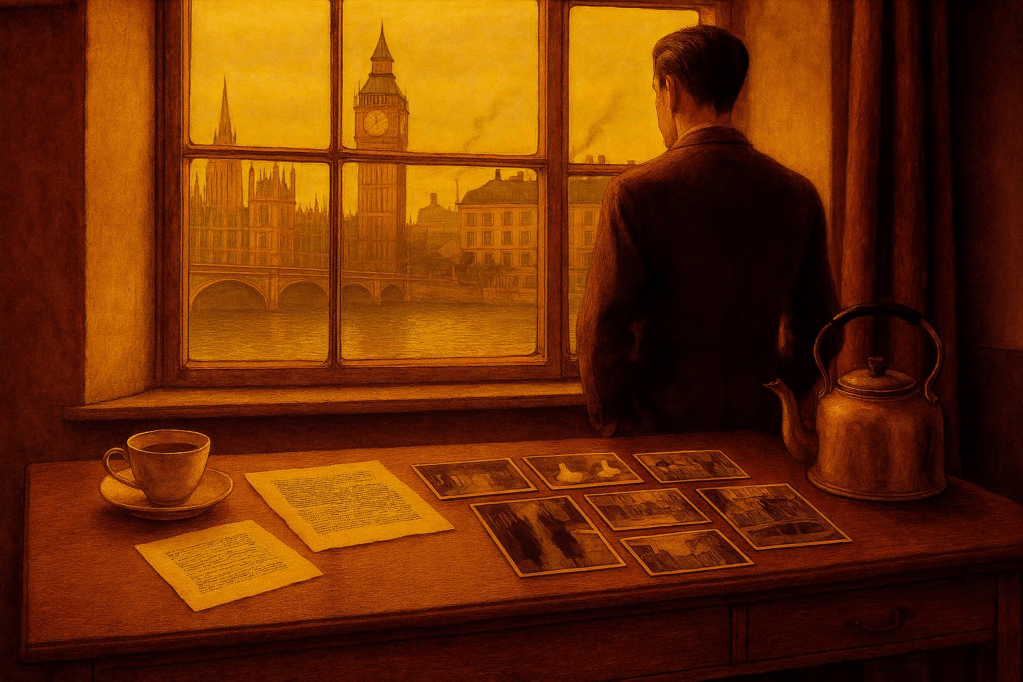
    The papers are spread across my desk. Rupert’s letters from 1941-1945. Marcel’s brief note from southern France. The Red Cross lists from liberated camps. Photographs—one in particular, taken in 1939 on my balcony at the Hôtel Montalembert. All seven of us, young and hopeful and alive: Miles, Marcel, Colette, Lucien, Élise, Antoine, Bernard.

    Three are dead now. I know that much. Bernard died during my imprisonment—heart failure in German custody. The others I learnt about later, through lists and letters and the slow reconstruction of what happened in the years between arrest and liberation.

    I need to write it down. All of it. Not just what I saw but what I learnt afterwards. Not to make it make sense—I don’t think it ever will, completely—but to testify. To remember. To make sure their deaths and their survival meant something.

    So I’m writing this final section from the future looking back, trying to piece together what happened to people I loved and left behind.


    1941-1942: London

    I recovered slowly. The weight came back, though I never quite filled out the way I had before Avenue Foch. Sleep remained difficult—nightmares about cells and interrogations and Bernard’s face when I learnt he’d died. But I worked. Pemberton gave me desk duties analysing intelligence from occupied France, coordinating with resistance networks, helping plan operations I could no longer participate in directly.

    I met with Rupert weekly. Sometimes at the Bloomsbury café, sometimes at his rooms near the university, once or twice at a church in Clerkenwell where I sat in the back and tried to pray without fully understanding what I was doing. He was patient with me, the way a good teacher is patient with a student who’s learning a difficult language. Faith, I discovered, was exactly that—a language I’d barely begun to speak.

    “You want certainty,” he told me one afternoon over tea. “You want to know why Bernard died and you didn’t. Why Marcel escaped and Lucien was caught. Why God saved you and not them. But faith doesn’t work like that. It’s not a mathematical formula where suffering plus prayer equals rescue. It’s trust in Someone sovereign even when His purposes aren’t legible to you.”

    “That’s hard.”

    “Yes. But it’s true.”

    So I learnt to pray differently. Not demanding understanding or rescue or fair outcomes. Just submission: You’re sovereign. I trust that. Even when I can’t see it. Even when people I love are still imprisoned and I’m free and none of it makes sense.

    Some days I believed it. Some days I just said the words and hoped they’d become true.

    In December 1941, the United States entered the war after Pearl Harbor. First time I felt something like hope—that maybe the tide could turn, that maybe liberation could come, that maybe the others were still alive to see it.


    1943-1944: The Turn

    The news from the Eastern Front came through intelligence reports in March 1943: heavy German casualties at Stalingrad, a major defeat, the tide of war shifting.

    Buried in one report was a casualty list. Officers killed in action. I scanned it without expecting to find anything relevant and then stopped on a name: Hauptmann Klaus Hartmann, Wehrmacht Cultural Affairs, KIA February 1943, Stalingrad.

    The Hartmann Problem, finally resolved—but not the way I’d expected. I felt grief, genuine and complicated. The man who’d saved Bernard’s life, helped Colette escape Berlin, bought Lucien’s paintings and chose not to report them, warned us repeatedly, secured Antoine’s release. He’d died frozen in Russia, serving ugliness he despised, a thousand miles from the city he’d tried to preserve.

    When I told Rupert, he was quiet for a long time. Then: “We can’t know what passed between Hartmann and God. Whether grace found him. Whether faith came in those final moments. That’s not ours to determine. But I know this—he made choices towards beauty whilst trapped in a system devoted to ugliness. Those choices cost him. Maybe cost him everything.”

    “Does that count for something?”

    “I think God’s economy is more generous than ours. That He sees the impossible positions people are trapped in and judges by the heart more than the uniform. But I don’t know. I can’t know. Neither can you.”

    “So we just—what? Hope?”

    “We trust that the Judge of all the earth will do right. That appointments kept in darkness matter, even when we can’t see how. That’s all we can do for the dead—trust God’s justice and mercy are larger than our understanding.”

    I did trust that, or tried to. Hoped that the man who’d chosen beauty when he could have chosen efficiency died knowing those choices had mattered. That somewhere in the accounting after death, buying coded paintings and protecting perfumers counted for something.

    By spring 1944, everyone knew liberation was coming. The question was when and how and whether anyone I’d left behind would survive to see it.

    I volunteered to return to Paris with the liberation forces. Role: intelligence liaison, identifying resistance members, helping coordinate the Allied advance. Pemberton approved it—I was still compromised, still known to German intelligence, but after liberation that wouldn’t matter.

    Rupert prayed with me before I left. “You’ll learn what happened to them. Some of it will be good news. Some won’t be. But you’ll know. And then you can grieve or celebrate or both.”

    “I’m not ready.”

    “No one ever is. But you’ll go anyway, because that’s what love does.”

    I left for France in June 1944, one week after D-Day. I spent the next two months with Allied intelligence during the Normandy campaign, helping identify resistance networks and coordinating information as the forces advanced toward Paris.


    August 1944: Liberation

    Paris was liberated on August 25, 1944.

    I entered the city with Allied forces—American and Free French, tanks rolling down the Champs-Élysées, flags waving, people cheering in the streets. Four years of occupation ending. The Germans fled or surrendered. The Gestapo headquarters at Avenue Foch was emptied, prisoners freed, files captured.

    The city was damaged but standing. Buildings scarred by bullets. Windows broken. Streets worn by military vehicles. But Notre-Dame still watched over the Seine. The cafés were opening. The fashion houses were planning collections. Paris had endured.

    I went immediately to Fresnes prison.

    They were processing released prisoners—hundreds of them, thin and worn and blinking in the August sunlight like people who’d forgotten what freedom looked like. I helped with identification, looking for faces I recognised, names I knew.

    And found one.

    Antoine Moreau. Twenty-four years old, looking forty. Thin to the point of starvation, a scar across his left cheek I didn’t remember, wearing clothes that hung on him like a scarecrow’s rags. But his eyes—his eyes were still certain.

    I walked up to him and he stared at me for three seconds as if I were a ghost. Then recognition broke across his face and he said, simply: “Miles. You came back.”

    “I never should have left.”

    “God is sovereign. Even over that.”

    We stood in the prison courtyard surrounded by freed prisoners and Allied soldiers and the chaos of liberation, and I pulled him into an embrace that probably hurt his ribs but neither of us cared.

    “The others?” I asked.

    “Uncle Lucien died. 1942. TB. I was with him at the end.” His voice was steady but I heard the grief under it. “He said to tell you the paintings mattered.”

    “They did.”

    “Colette—they transferred her. Ravensbrück. I don’t know if she survived.”

    I’d already checked the Red Cross lists that morning—compiled from liberated camps, processed frantically in the chaos of Paris’s first free days. Found her name typed in small letters on a long roster of French women who’d been deported and died: Marchand, Colette. Age 28. Ravensbrück. Died winter 1943-44.

    No more specific date. No details about how. Just the flat bureaucratic acknowledgement that the woman who’d wanted to be beautiful and dangerous, who’d walked runways with codes in her scarves and pulled a gun on a Gestapo officer, had died in a camp amongst thousands of other women whose names were also on lists.

    “She didn’t make it,” I said. “Winter ’43-’44. Ravensbrück. No other details.”

    Antoine closed his eyes. Nodded once. “She knew the risk. When she pulled that gun.”

    “Yes.”

    “Élise—I don’t know. They separated us. I heard she was sent to forced labour but I don’t know where or if she’s alive.”

    “We’ll find out.”

    “And Marcel?”

    Antoine’s face did something complicated—grief and joy and relief all mixed. “Escaped. I heard he made it to southern France. Survived the occupation there.”

    “One. At least one besides us.”

    “Yes.”

    We stood there whilst Paris celebrated around us, two survivors of Avenue Foch trying to calculate the cost of beauty and resistance and whether three dead out of seven meant we’d won or lost or something more complicated than either word could capture.

    “Your faith held,” I said finally.

    “Yes. God held me. Not rescued from it. Just sustained through it. Like He promises.”

    “You were right. About everything.”

    “I know.” No arrogance in it. Just certainty. “You understand now?”

    “I’m beginning to.”


    1945: The Accounting

    The war in Europe ended May 8, 1945. Germany surrendered. The camps were liberated. The full horror became visible—the lists of dead, the photographs, the survivors who weighed thirty kilos and had numbers tattooed on their arms.

    I searched the Red Cross lists obsessively. Confirmed Colette’s death. Found dozens of people I’d worked with, informants and contacts and resistance members whose names I’d sent to London in intelligence reports. Most were dead.

    In June 1945, a letter arrived at Pemberton’s office, forwarded to me:

    Miles,

    I’m alive. Forced labour in Germany, laboratory. The Allies liberated us in April. I’m in a displaced persons camp now, waiting for transport home. They say it could be weeks or months before I can return to Paris.

    Father is dead. I knew that—Weber told me during interrogation. But I needed to write it. Make it real.

    Colette?

    —Élise

    I wrote back immediately, sent it through Red Cross channels: Colette dead, Ravensbrück, winter 1943-44. Lucien dead, TB, 1942. Marcel alive, Paris. Antoine alive, Paris.

    She returned to Paris in late August 1945. I met her at the train station with Antoine. We stood on the platform waiting, and when she stepped off the train I barely recognised her.

    Twenty-eight years old but looking older. Thin—not skeletal like the worst camp survivors, but worn down to essential elements. Still wearing white, somehow—a lab coat someone had given her. Still wearing only a watch, no jewellery. Her eyes behind the glasses were the same—brilliant and owlish—but haunted now.

    She saw us and stopped. Just stood there on the platform with a small bag containing everything she owned, staring at the two of us as if we might disappear if she blinked.

    Antoine moved first. Walked up to her, said: “Élise. You made it.”

    “I don’t know why.” Her voice was rough. “Father died. Colette died. Lucien died. Why did I survive?”

    “God’s purposes,” Antoine said simply. A tear rolled down his cheek. “Not ours to understand. Just ours to trust.”

    She looked at me. “Miles. I heard you were exchanged. 1941. That you were safe in London whilst we—” She stopped. “I’m not angry. I’m glad you survived. But I need you to know: Father’s death wasn’t your fault. Weber told me what you tried to do. The trade you offered. It wasn’t your fault.”

    I’d been carrying that guilt for four years. Hearing her absolve me of it didn’t remove the weight entirely, but it shifted something. Made it bearable.

    “I’m sorry,” I said anyway. “For all of it.”

    “I know.”

    We took her to a café—one of the few that was open, serving watered-down coffee and yesterday’s bread. She told us what she could about the forced labour, the lab work, the years of survival through chemistry and stubbornness. We sat together—three survivors of seven—and tried to make sense of what we’d lost and what we’d kept and whether resistance meant anything when the cost was three lives and years of imprisonment and grief we’d carry forever.

    “The perfume formulas,” Élise said finally. “The ones Father and I developed. The invisible inks, the compounds. Did any of them matter? Did they help?”

    “Yes,” I said. “The intelligence we sent to London—it helped Allied planning. Pemberton confirmed it. Your formulas made it possible.”

    “Then it mattered.” She said it firmly, as if needing to believe it. “Even if Father didn’t live to see it. Even if most of us died. It mattered because we refused to let them win completely. We embedded beauty in codes and made hope smell like roses and said no to ugliness even when ugliness killed us.”

    “Yes,” Antoine agreed. “It mattered because God ordained it to matter. Not because we won easily. Because we resisted faithfully.”

    We sat in the café as Paris lay in disrepair around us, three survivors bearing witness to the dead, and I thought about Colette’s beauty turned to ash and Lucien’s paintings still hanging somewhere with codes in their wallpaper and Bernard’s quiet dignity and whether any of it added up to more than loss.

    It had to. Because if it didn’t, then what had any of us died for?


    October 1946: Return

    Which brings me to now. To this morning, standing in my London flat with papers spread across my desk and a train ticket to Paris in my pocket.

    I’m going back. Five years since I left as a prisoner exchanged. Two years since I returned with liberation forces. One year since Élise returned from forced labour. Time to see if the city we fought for still recognises me. Time to visit graves and surviving members and the streets where we’d embedded beauty in small acts of defiance.

    Time to see if Rue de l’Espoir has recovered.

    The train to Paris is crowded with people returning—expatriates who’d fled, soldiers going home, businessmen resuming trade. I sit by the window and watch the French countryside pass, thinking about the last time I’d made this journey in August 1941, leaving the others behind.

    Paris looks different in October 1946 than it did in August 1944. Less celebratory. More worn. The scars of occupation visible in damaged buildings, closed shops, streets that need repair. But also: life returning. Cafés open. People walking without fear of checkpoints. The sound of French instead of German commands.

    I go first to the Hôtel Montalembert. Still standing, operating, a few guests beginning to return. I didn’t think the desk clerk recognised me—five years and a different person entirely. I don’t go up to what was my room. Don’t need to. Just wanted to see that it endured.

    Then to Rue de l’Espoir.

    The narrow curved street looks exactly as I remember it. The defunct fountain still dry. The 18th-century buildings still the colour of old bone. The faded green shutters. And Marcel’s shop—

    Open.

    The sign above the door has been repainted: Marcel Duval, Tailleur. The mannequin in the window wears a charcoal suit of exquisite tailoring. Through the window I can see shelves of fabric, measuring tapes, the tools of a trade practised with precision and care.

    I push open the door. A bell rings. And Marcel looks up from his worktable where he’s stitching something with the careful focus I remember.

    He’s older. Greyer. Forty-nine now, lines around his eyes that weren’t there in 1941. But his hands are steady and his eyes still assess me with that mixture of pragmatism and something softer.

    “Miles Penbury,” he says. Not surprised. As if he’d been expecting me.

    “Marcel.”

    He sets down his needle. Stands. And we grip hands—British restraint barely holding against the urge to embrace.

    “You look better than when I saw you last,” he says. “Less starved.”

    “Five years of British rations. You look steady.”

    “I am. Provence treated me well. Though I’m glad to be back.” He gestures to the shop. “Reopened October 1944. Been stitching jackets for Parisian women ever since. No codes anymore. Just honest tailoring.”

    “Aspirational hope?”

    “Vindicated. The street still stands. So do we.”

    “Three don’t.”

    “I know. Antoine told me. He comes by weekly—still working as a courier, legitimate now. Élise I’ve seen twice. She works at Guerlain now, developing formulas. Won’t talk much about what happened. But she’s alive. She endures.”

    “And you posted my letter. To Rupert.”

    “I did. Before I fled. Thought you’d want him to know you weren’t saying no anymore.”

    “Thank you.”

    Marcel moves to a shelf, pulls down a bottle. I recognise it immediately: formula #17. The perfume Élise gave me Christmas Eve 1940. The one that smells like hope.

    “She left this with me. Wanted you to have it again. Said you’d understand.”

    I take the bottle. Uncork it. The scent is exactly as I remember—roses and something sharp and something clean that I can’t name. Hope bottled in glass and fragrance, surviving occupation and arrest and the death of its creator.

    “We’re meeting tonight,” Marcel says. “The survivors. Thought you might be coming around this time. Antoine suggested it. We gather once a year anyway, anniversary of the arrests. But this year, with you here—” He pauses. “We’ll be at the old wine cellar. The one in the 12th where we used to meet. Eight o’clock. If you want to come.”

    “I’ll be there.”

    I spend the afternoon walking. Past Parfums Garnier—still closed, building for sale, windows dark. Past the Galerie Rousseau—reopened under new management, Madame Rousseau’s name forgotten. Past the Hôtel Meurice where Hartmann had his office—now returned to being a hotel, no trace of Wehrmacht occupation visible.

    And finally to Notre-Dame.

    She stands eternal, watching over the Seine as she’s done for centuries. The bells are ringing now—no longer silenced by occupation. The rose windows catch afternoon light. People are going inside to pray or simply to witness that it survived, that beauty endured, that something permanent remained whilst everything else changed.

    I stand on the Left Bank and look at her and think about Rupert’s favourite verse: The light shines in the darkness, and the darkness has not overcome it.

    It’s true. I can see it now. Paris survived. Notre-Dame stands. Rue de l’Espoir still curves between old buildings. Marcel stitches jackets. Antoine still believes. Élise still makes perfume. And I—I learnt to pray in a cell at Avenue Foch and somehow that faith held through five years of war and grief and not understanding why some died and some survived.

    The darkness did not overcome it. Battered, dimmed, purchased at terrible cost—but the light endures.


    The wine cellar in the 12th looks exactly as I remember it. Damp stone walls, empty bottles on shelves, the smell of fermentation and old wood. We’d met here in February 1941 to debate the trap we were walking into. Five years later, four of us return.

    Marcel arrives first, brings wine and bread—proper wine now, not the thin stuff we’d had during occupation. Then Élise, wearing a lab coat like armour, but now pink and new. Then Antoine, thin still but steady, eyes certain as ever.

    We sit on old crates and barrels. Pour wine into mismatched glasses. And look at each other with the complicated recognition of people who survived when others didn’t.

    “To Bernard,” Marcel says, raising his glass. “Who died saving nothing, but died bravely anyway.”

    “To Bernard,” we echo.

    “To Lucien,” Antoine adds. “Who painted beauty and embedded codes and died before liberation. He said to tell everyone the paintings mattered.”

    “They did,” I say. “The intelligence they carried helped Allied operations. Pemberton confirmed it.”

    “To Lucien.”

    “To Colette.” Élise’s voice is steady but quiet. “Who wanted to be beautiful and dangerous. She was both.”

    “To Colette.”

    We drink. The wine is better than anything we’d had during occupation but it tastes of grief anyway. Three dead. Four living. The arithmetic of resistance written in names and graves and the spaces where people should be sitting but aren’t.

    “Did it matter?” Élise asks suddenly. “All of it. The codes, the formulas, the intelligence we sent. Were three deaths too high a price for what we accomplished?”

    “Yes,” Antoine says immediately. “Not because we won easily or because everyone survived. Because God ordained our resistance to matter. He was sovereign over all of it—the occupation, the arrests, the deaths. And He says it mattered.”

    “That’s not an answer,” Élise objects. “That’s theology.”

    “It’s both.”

    Marcel speaks carefully: “The intelligence we sent to London helped Allied planning. Miles confirmed that. So in a practical sense—yes. What we did contributed to victory. Small contributions, but real.”

    “And in the impractical sense?” Élise presses.

    I think about what to say. About Bernard dying in a German cell. About Colette’s name on a camp list. About Lucien’s unmarked grave. About the terrible cost of beauty resisting ugliness.

    “We refused to let darkness extinguish all light,” I say finally. “We embedded beauty in codes and wore defiance on runways and made perfume that smelt like hope. We said no to ugliness even when ugliness killed us. And Paris stands. Notre-Dame stands. This building and cellar still exists. We preserved what was worth defending. That’s what mattered. Not that everyone survived. That we refused to surrender beauty completely.”

    “And faith?” Élise looks at me. “You found it, didn’t you? In Avenue Foch. Antoine told me.”

    “Yes. I can’t explain it fully. Just that God made an appointment with me in the darkness. Removed my heart of stone and gave me a heart of flesh, exactly like the scripture says. And I’ve been learning to trust Him ever since. Learning that His purposes don’t have to be legible to me to be real.”

    “I don’t have faith,” Élise says. “Father didn’t believe. I still don’t. But I survived. And I’m still making perfume. And maybe that’s enough.”

    “It is,” Antoine says gently. “God’s grace extends to you whether you recognise it or not. You’re alive. You endure. That matters.”

    We sit in silence for a while. Then Marcel asks: “What do we do now? Tomorrow? Next year? The rest of our lives?”

    “We remember,” I say. “We visit graves and tell stories and make sure the dead aren’t forgotten.”

    “We work,” Marcel adds. “I stitch jackets. Élise makes perfume. Antoine delivers packages. Miles—what do you do now?”

    “I write. Intelligence reports mostly. But also this—” I gesture vaguely. “An account of what we did. For memory.”

    “Good,” Marcel says. “Someone should write it down. Make sure people know.”

    “All of it,” Élise says quietly. “Not just what we accomplished. What it cost. Who we lost.”

    “Yes,” Antoine agrees. “Bernard and Lucien and Colette. Their names. Their choices. What they gave.”

    “And we honour them by continuing,” Marcel says. “By doing the work they can’t. By being here when they’re not.”

    We sit in silence for a moment longer. Then near midnight, we leave the wine cellar and embrace—less restrained now, my British reserve finally giving way to something more honest. We promise to meet again, then scatter into the Paris night.


    The next morning, we visit Bernard’s grave.

    The cemetery is in the 14th arrondissement, a quiet place with chestnut trees that are losing their leaves. Bernard’s stone is simple: Bernard Garnier, 1878-1941, Parfumeur. No epitaph. Just his name and trade.

    Élise stands beside me. Antoine too. Marcel arrived separately but joined us without speaking. The four of us who remain, visiting the first who fell.

    “He would have hated dying for nothing,” Élise says finally. “He was practical. Hated waste.”

    “He didn’t die for nothing,” Antoine replies. “He died so you could live. That’s not waste.”

    “I’m not sure he’d agree. The trade failed. Miles was arrested anyway. Weber got everything he wanted.”

    “But you’re here,” I say quietly. “Standing at his grave. Still making perfume. Still creating beauty. That’s not nothing.”

    She nods but doesn’t speak.

    We stand in silence whilst Paris moves around us—traffic, voices, the ordinary sounds of a city rebuilding. Then we leave, separately, each of us carrying whatever meaning we can make from an old man’s death in German custody.


    I walk back to my hotel slowly, thinking about those who aren’t here. Lucien in that overgrown field at Fresnes. Colette in a mass grave at Ravensbrück with no stone, no ceremony, no way to visit or remember except to say her name and believe that beauty and danger together meant something.

    Tomorrow I’ll walk Rue de l’Espoir again and remember when seven of us met on a balcony at the Hôtel Montalembert to embed beauty in codes and resist ugliness with fashion and perfume and paint.

    Tomorrow I’ll return to London and continue writing this account, trying to testify to what we did and what it cost and whether any of it mattered.

    But tonight, I stand outside Notre-Dame one more time and look up at her towers against the October sky.

    Five years since I walked out of Avenue Foch. Four years since Paris was liberated. One year since the war ended. And she still stands. Still watches over the Seine. Still endures whilst everything else changes.

    The light shines in the darkness, and the darkness has not overcome it.

    I believe that now. Not because I understand suffering or God’s purposes or why some died and some survived. But because Someone made an appointment with me in a cell at Avenue Foch, and I learnt that appointments kept in hell are more certain than certainties claimed in comfort.

    Bernard is dead. Colette is dead. Lucien is dead. Three of seven gone. But Marcel stitches jackets on Rue de l’Espoir. Antoine’s faith held. Élise endures. I found grace I didn’t deserve. And Paris—Paris still stands.

    That has to be enough.

    Because it’s all we have. And because Someone sovereign says it matters, even when we can’t see how.

    So I’ll remember them. Write their names. Visit their graves. Tell their stories. And trust that beauty embedded in codes and hope bottled in perfume accomplished what God intended, even when the cost was everything.

    The war is over. The occupation ended. But the light still shines.

    And that, somehow, is enough.


    On my final evening in Paris, I returned to the Hôtel Montalembert. I’d stayed at a modest hotel near Gare du Nord the previous nights, but wanted to spend this last night here, in room 412—my old room.

    The desk clerk had it ready for me.

    I climbed the stairs slowly. Passed a maid in the hallway, gaunt and disheveled, scurrying past me toward the stairs with her head down.

    I glanced back, sensing something. But she’d already disappeared down the stairwell.

    I unlocked the door.

    The room looked the same. Different furniture, perhaps, but the proportions were right. The light from the window. The door to the balcony still in the same place. I could almost smell formula 17—memory playing tricks, nostalgia for what we’d lost.

    I set my jacket and hat on the chair. Poured a glass of water from the pitcher on the nightstand. And opened the balcony door.

    I walked out and the memories flooded over me—seven of us gathered here in 1939, planning resistance through beauty, believing codes embedded in perfume and paintings and fashion would somehow matter. Three of them were dead now.

    I sat in one of the cast iron chairs. Put my water glass on the small table. Looked out at Notre-Dame, her towers against the October evening sky.

    A tear formed. I let it fall.

    After a while, I went back inside. Sat on the edge of the bed to pull off my shoes.

    That’s when I noticed the box on the chair by the desk.

    Someone had delivered it—the top was already loosened, as if it had been opened and carefully closed again. I pulled off the lid.

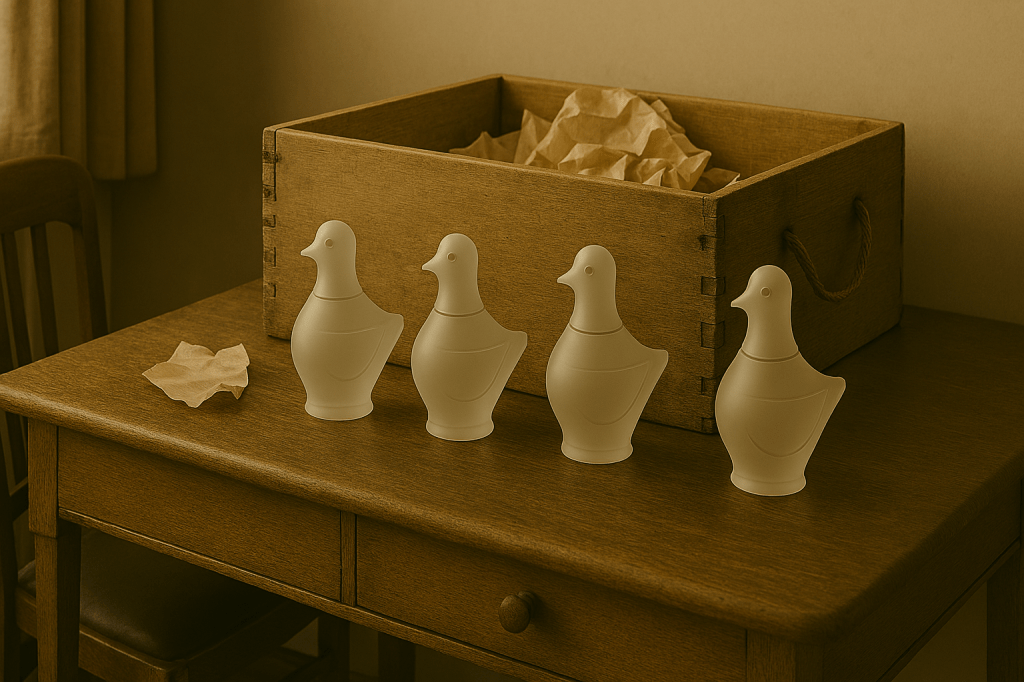
    Inside: half a dozen dove-shaped perfume bottles. Bernard’s signature design. Crystal glass, each one perfect.

    A note in Élise’s handwriting:

    Miles—Father would have wanted you to have these. They were in storage at the shop. I couldn’t bear to sell them. Perhaps you can’t either. Perhaps that’s enough. —É

    I picked up one of the bottles. Held it to the light.

    The scent hit me—roses and something sharp and clean. Not memory. Real. Fresh. As if someone had just uncorked it moments before.

    Which meant someone had just handled these bottles.

    Which meant that smell in the hallway wasn’t nostalgia.

    Wait.

    That maid…

    THE END
  • The Balcony – The Cost

    The Balcony – The Cost

    Paris fashion show at the Palais Galliera, under German occupation 1939

    The Cost

    Episode 8: The Cost

    Paris, October—December 1940   
    …as remembered in London, October 1946


    Catherine Wells broke on the fourth day.

    I didn’t know this when it happened. None of us did. We were scattered, maintaining dead drops, communicating through messages left in agreed locations and picked up hours later. The system was slower, more cautious, designed to survive exactly what was happening: one of us in Avenue Foch, Weber’s patient questions stripping away layers of cover until nothing remained but truth.

    The news came through Hartmann, delivered via a note left at the wine merchant’s shop where we’d been meeting in the 5th arrondissement. The merchant’s cousin—a woman who asked no questions and remembered nothing—handed me a folded paper when I came to inspect a supposed shipment of Burgundy.

    She gave them a name. Not yours. Not the cell. But someone connected. A gallery owner in the 7th who facilitated meetings between British agents. Weber has arrested him. Two others from his network. She’s still talking. Move everyone. Again. —K.H.

    I burnt the note in an alley behind the shop, watching paper curl and blacken, and thought about how Catherine had lasted longer than I’d expected. Four days before breaking. Four days of isolation and cold and Weber’s methodical dismantling of resistance.

    Most people broke faster.

    She’d been brave. And bravery hadn’t mattered.


    We met that night in yet another location: an apartment above a pharmacy in the 11th arrondissement that belonged to Marcel’s second cousin, a woman who’d moved south in June and left her key with family. Empty rooms. Dust. The smell of abandonment.

    All of us came separately. Marcel first, then Élise, then Lucien. Colette arrived last, wearing a shapeless coat that made her invisible, her face drawn and older than her twenty-seven years.

    “Weber knows,” I said without preamble. “Catherine broke. Gave him a gallery owner. The man’s arrested along with his network.”

    “Which gallery?” Marcel asked.

    “She didn’t know specifics. Hartmann said 7th arrondissement. Someone who facilitated meetings.”

    “Madame Rousseau?” Lucien’s voice was tight.

    “Possibly. Or someone else. There are a dozen galleries in the 7th that handle discreet business.”

    “We should warn her,” Élise said.

    “And reveal we know about the arrests? That we have intelligence sources inside German command?” I shook my head. “No. If she’s the one, she’s already arrested. If she’s not, warning her makes her suspicious.”

    “So we do nothing,” Lucien said bitterly. “Let people get arrested because contacting them is too dangerous.”

    “Yes. That’s exactly what we do.”

    He stood, walked to the window, looked out at the dark street. “This is what we’ve become. People who calculate who’s worth saving and who’s acceptable loss.”

    “We’ve always been that,” Colette said quietly. “We just didn’t want to admit it.”

    We sat in heavy silence, in an empty apartment that smelt of dust and old perfume, considering what we’d known all along: resistance meant choosing. Who to help. Who to abandon. Who to sacrifice so that others might survive.

    It wasn’t noble. It was arithmetic.


    The next morning, I went to the Galerie Rousseau.

    The shutters were closed. A sign on the door: Fermé jusqu’à nouvel ordre. Closed until further notice.

    I tried the door anyway. Locked. Peered through the window. The gallery was empty—not just of people but of paintings. The walls were bare. The furniture remained but the art was gone, as if someone had systematically stripped the space of everything that mattered.

    A woman sweeping the shop next door saw me looking.

    “The owner was arrested,” she said, not bothering to lower her voice. Occupation had taught Paris that whispers and silence made no difference. “Two days ago. Germans took her and everything in the gallery. Paintings, records, everything.”

    “Do you know why?”

    “Does it matter? They don’t need reasons. They just take what they want.” She returned to her sweeping, the sound of bristles on stone marking the rhythm of a city learning to survive by not caring.

    I walked away slowly, hands in pockets, looking like a disappointed customer rather than someone who’d just lost an ally and safe meeting place. Madame Rousseau, shrewd and careful, had facilitated too many discreet meetings. Had let too many people use her back room for conversations that looked innocent but weren’t.

    Catherine hadn’t known her name. But Weber was methodical. He’d taken the gallery owner Catherine had mentioned, interrogated him, followed the threads. Found Madame Rousseau. Taken her paintings, her records, her freedom.

    She was sixty. She wouldn’t survive Avenue Foch.

    I thought about warning the others, about all the people we’d met through her gallery, about the network of contacts who thought art and commerce made them invisible.

    Then I thought about Lucien’s bitter words: People who calculate who’s worth saving and who’s acceptable loss.

    I went back to my boarding house in the 20th arrondissement and did nothing.

    Because doing nothing was the only way to keep doing anything at all.


    Colette saw Weber three days later.

    Not because she wanted to. Because he sent a car with two soldiers who knocked on her door at eight in the morning and said Sturmbannführer Weber requested her presence for breakfast at the Meurice. The phrasing—requested—made clear it wasn’t a request.

    She came to the empty apartment that night, her hands shaking slightly when she lit a cigarette.

    “He knows about Catherine,” she said. “Talked about her like they were old friends. Said she’d been misguided. Working for the wrong people. That it was tragic she’d chosen violence over cooperation.”

    “Did he mention you?” Marcel asked.

    “Not directly. But he—” She paused. “He asked if I knew any other British agents in Paris. Said the war was going to end soon, that Germany would win, that people who cooperated now would be remembered as practical. People who resisted would be remembered as traitors.”

    “What did you say?”

    “I said I was a model, not a spy. That I knew buyers and designers and people in fashion, but I had no interest in politics.” She drew on her cigarette. “He smiled. Said that was wise. Then he asked if I’d be willing to model for a fashion show the Germans are planning. French-German cooperation. Demonstrating that life continues under occupation. Very civilized. Very proper.”

    “You said yes,” I guessed.

    “I said I’d consider it. That I needed to check my commitments.” She looked at each of us. “But I’m going to say yes. Because saying no means I’m suspicious. And being suspicious means Avenue Foch.”

    “You’re getting too close,” Élise said. “Playing too deep.”

    “I’ve been too close since Berlin. Too deep since I put on that engagement ring for photographs.” She stubbed out her cigarette with more force than necessary. “But what’s the alternative? Run? Hide? Use Véronique’s papers and become someone else?”

    “Yes,” Lucien said immediately.

    “And abandon everything we’ve built? Let Weber win by default?” She shook her head. “No. I’m staying. Modeling their propaganda. Smiling at their officers. Being exactly what they expect: a beautiful French woman who’s chosen cooperation over principle.”

    “That’s not who you are,” Élise said quietly.

    “No. But it’s who I need them to think I am.” Colette stood, gathered her coat. “Weber’s smart. Patient. He suspects everyone and trusts no one. The only way to survive him is to be so boring, so predictable, so obviously non-threatening that he stops watching closely.”

    “That’s not a strategy,” Marcel objected.

    “Yes. And right now, hoping is all I have.”

    She left through the back stairs, disappearing into the October night, and I wondered how long someone could pretend to be harmless before the pretense became real.


    I received a letter from Rupert two days later, delivered through the mysterious channels that had been working all autumn:

    Miles,

    I don’t know what’s happening—your silence suggests something difficult—but I want you to know: loss is not failure. Sometimes faithfulness looks like surviving. Sometimes resistance is just refusing to stop when stopping would be easier.

    I’ve been reading Bonhoeffer’s letters. He’s in Germany now, watching his country destroy itself, trying to decide whether to stay or flee. He wrote: “When Christ calls a man, he bids him come and die.” Not necessarily physical death. But death to safety. Death to comfort. Death to the illusion that we can serve God without cost.

    You’re paying that cost now. I can sense it in what you’re not saying. Remember: the cost is not the same as waste. What you’re losing matters. But it matters because it’s worth losing for something larger.

    Keep praying. Even when prayer feels useless. Especially then.

    The Presslings ask about you. They’re praying too.

    —R.

    P.S. Read the Book of Job if you haven’t. Not for answers. For company.

    I kept the letter in my jacket pocket, pulling it out occasionally to reread. Not because it comforted me—it didn’t. But because it named what I was feeling: the sense of paying costs I couldn’t afford, losing things I couldn’t replace, watching people disappear into Avenue Foch or German arrests or the grinding machinery of occupation.

    Madame Rousseau. Catherine Wells. The gallery owner whose name I didn’t know. The network of people who’d thought art and beauty made them safe.

    All gone. All cost.

    And we remained, scattered and cautious and calculating who was worth saving next time Weber came asking questions.


    The fashion show was scheduled for November 15th, at the Palais Galliera, sponsored by German occupation authorities and featuring French designers who’d chosen cooperation over closure. The invitation list included Wehrmacht officers, Vichy officials, German industrialists’ wives, and carefully selected French society figures who wanted to demonstrate that Paris remained Paris even under swastikas.

    Colette was listed as one of the featured models.

    “It’s propaganda,” Marcel said when we met to discuss it, this time in a storage room behind a printer’s shop in the 15th that printed German occupation notices and therefore had reason for people coming and going at odd hours. “She’s legitimizing occupation. Making it look civilized.”

    “She’s surviving,” I corrected. “And gathering intelligence. She’ll see who’s there. Who’s comfortable with Germans. Which French are collaborating openly.”

    “That’s not worth the cost to her soul.”

    “Maybe not. But that’s her choice to make.”

    We’d been having versions of this argument for weeks. Marcel saw cooperation—even false cooperation—as betrayal. I saw it as tactics. Neither of us was wrong. Neither of us was right.

    The war had made morality into arithmetic, and none of us knew how to calculate correctly.


    I didn’t attend the fashion show. Too visible, too connected to the industry, too likely to be noticed by Weber or his people. But Lucien went, posing as an art critic covering cultural events for a small journal that paid him occasionally for reviews. He stood in the back, took notes, sketched quick impressions of the crowd.

    He came to the printer’s storage room two days later, looking older and more tired than I’d seen him.

    “It was obscene,” he said without preamble. “German officers and their wives sitting in the front row. Vichy officials preening. French designers showing collections like nothing had changed. And Colette—” He stopped. “She was perfect. Beautiful and smiling and gracious. Wore German-approved designs. Made polite conversation with officers during the reception. Played the role flawlessly.”

    “That’s what she’s supposed to do,” Élise said.

    “I know. But watching her do it—” He shook his head. “It looked real. That’s what terrified me. It looked like she actually enjoyed it. Like she’d become what she was pretending to be.”

    “She hasn’t,” I said, though I wasn’t entirely certain.

    “How do you know? How does she know? Where’s the line between pretending to collaborate and actually collaborating? Between playing a role and becoming it?”

    No one answered. Because none of us knew.


    Winter came early that year, bringing cold that settled over Paris like occupation itself—inescapable, grinding, making everything harder. Coal was rationed. Food was scarce. The Germans requisitioned buildings for their own use, displacing French families who had nowhere else to go.

    And we continued our work, such as it was. Marcel stitched codes into the linings of coats for German officers’ wives, embedding intelligence about troop movements overheard during fittings. Élise developed formulas that looked like perfume samples but contained compounds that could reveal hidden inks or corrode documents slowly over weeks. Lucien painted safe, boring pictures and attended galleries where German officers discussed art and, occasionally, military matters they thought no one was listening to.

    I maintained my cover as an importer, though importing had become nearly impossible with borders closed and shipping restricted. I met with German procurement officers, discussed fabric contracts that would never be fulfilled, smiled and nodded and played the role of boring English businessman who cared more about commerce than politics.

    And all of us sent intelligence to London when we could, through methods that grew increasingly dangerous as German security tightened. Dead drops. Coded messages hidden in legitimate correspondence. Occasionally, when absolutely necessary, face-to-face meetings with contacts whose names we didn’t know and wouldn’t remember if arrested.

    It wasn’t glorious. It wasn’t heroic. It was grinding, daily, careful work that accomplished small things and cost everything.


    The call came in late November, just as the first snow began to fall.

    Not a call exactly—a message left at the printer’s shop, written in handwriting I recognised as Hartmann’s:

    Weber has discovered my involvement. He hasn’t arrested me yet—political complications, my family connections—but I’m being transferred. Eastern Front. Punishment disguised as duty. This is my last warning: he’s planning a sweep. Multiple arrests. Before Christmas. Anyone connected to British intelligence, art galleries, fashion industry networks. Dozens of people. He’s been building cases for months. Catherine gave him the first name. Others have given him more. Get out if you can. If you can’t, hide deeper than you’ve ever hidden. —K.H.

    I burnt the note immediately, but the words remained.

    Before Christmas. Multiple arrests. Dozens of people.

    We met that night—all of us, together, for the first time in weeks—in the empty apartment in the 11th. It was too dangerous, too visible, but Hartmann’s warning demanded immediate coordination.

    “We can’t all run,” Marcel said. “Too visible. Too suspicious.”

    “We can’t all stay,” Lucien countered. “If Weber’s planning a sweep, anyone connected to galleries or fashion or British agents is a target.”

    “That’s all of us,” Élise said quietly.

    “Yes.”

    We sat in silence, calculating odds, considering options, knowing that whatever we chose would cost someone everything.

    “I have to stay,” Colette said finally. “If I disappear now, after modeling their show, after having breakfast with Weber—it proves I was hiding something. It puts everyone I’ve ever spoken to under suspicion.”

    “You’ll be arrested,” Lucien said.

    “Maybe. Or maybe I’m too visible now. Too useful as propaganda. Too connected to German approval to arrest without creating problems.” She paused. “I’m gambling that cooperation—false cooperation—has made me too valuable to touch.”

    “That’s not a bet I’d take,” Marcel said.

    “Good thing it’s not your bet to make.”

    I looked at each of them, these people who’d become a cell through accident and necessity, and tried to calculate who could leave and who had to stay. Who was most at risk and who was most valuable. Who we could afford to lose and who we couldn’t survive without.

    The arithmetic of resistance. The cost we’d been paying all along.

    “Marcel,” I said finally. “You can leave. Close your shop. Claim you’re visiting family in the south. Use Véronique’s papers if you need to. You’ve been careful—you’re probably not on Weber’s list.”

    “Probably isn’t certainly.”

    “Nothing is certain. But you have the best chance of getting out safely.”

    He considered this, his face unreadable. Then: “No. I’m staying. My shop, my work, my clients—they’re my cover. Leaving breaks that cover. Makes me suspicious. I stay.”

    “Élise?” I turned to her.

    “I can’t leave. Father needs me. The perfume lab needs me. And—” She paused. “And if I run, Bernard becomes an easy target. Weber will pressure him to find me. I stay to protect him.”

    “Lucien?”

    “My nephew is being watched because of me. If I flee, Antoine becomes a target.” He looked at me. “I stay.”

    I’d known they would. All of them. Because leaving meant abandoning cover, abandoning people, abandoning the work. Because resistance wasn’t just about fighting—it was about remaining. Being present. Refusing to disappear.

    Even when disappearing would be smarter.

    Even when staying meant arrest.

    Even when the cost became unpayable.

    “Then we prepare for the sweep,” I said. “Destroy everything incriminating. Move everything sensitive. Create alibis and cover stories. And—” I looked at each of them. “—we accept that some of us might not survive Christmas.”


    The sweep began on December 10th.

    I wasn’t arrested. Neither was Marcel or Élise or Lucien or Colette. We’d been careful, compartmentalized, protected by covers that held under scrutiny.

    But dozens of others weren’t as fortunate.

    Gallery owners across Paris. Fashion house staff. Perfume distributors. People who’d facilitated meetings or passed messages or simply knew too many foreigners. Weber had been building his cases for months, using Catherine’s initial confession to map networks, following threads, being methodical and patient and absolutely thorough.

    The arrests continued for a week. Each day brought news of more people taken to Avenue Foch. Each night brought the sound of trucks moving through dark streets, carrying prisoners to prisons or deportation or executions.

    Paris learnt to look away. To not notice. To survive by seeing nothing.

    And I stood on the narrow balcony of my boarding house in the 20th arrondissement, looking out at a city under snow and occupation, and prayed prayers that felt increasingly futile.

    Keep them alive. Keep them strong. Don’t let the darkness win.

    Show me how this serves your purposes.

    Show me how cost becomes meaning.

    But the only answer was silence and snow and the distant sound of German trucks rolling through occupied Paris.


    I didn’t see Hartmann before he left. He was transferred quietly, efficiently, shipped east towards a front where German soldiers were discovering that Russia was larger and colder and more determined than they’d expected.

    His last message arrived through the wine merchant, delivered by the cousin who asked no questions:

    I tried to help. I failed more than I succeeded. But I tried. Tell Lucien his paintings are beautiful. Tell Colette she’s braver than she knows. Tell Miles that choosing beauty over ugliness matters, even when beauty loses. Especially then. —K.H.

    I burnt it like I’d burnt all his messages. Then I went to a church in the 18th arrondissement—empty and cold, smelling of incense and stone—and sat alone in a pew, trying to pray, trying to understand.

    Hartmann was gone. Probably to die in Russia, like thousands of other German soldiers who’d been sent east as punishment or duty or the grinding requirements of war.

    The Hartmann Problem—the man who loved beauty but served ugliness—had been solved by removing him from the equation.

    It didn’t feel like a solution. It felt like loss.


    Christmas came quietly to occupied Paris. No celebrations. No joy. Just the mechanical observation of a holiday that felt increasingly irrelevant in a city where Germans celebrated and French endured.

    We didn’t meet as a cell. Too dangerous after the sweep. Too visible. Too likely to draw attention when Weber was still processing arrests and building new cases.

    But on Christmas Eve, a small package arrived at my boarding house, delivered by a street child who vanished before I could ask questions.

    Inside was a bottle of perfume. No label. Just glass and scent.

    And a note in Élise’s careful hand:

    Number 17. The formula you asked about last summer. It reveals hidden messages under heat. Also: it smells like hope. Merry Christmas. We’re still here. —É.

    I held the bottle, feeling its weight, smelling roses and something else—something sharp and clean and impossible to name.

    Hope, Élise had said. It smells like hope.

    I didn’t know if I believed that. But I kept the bottle anyway, hiding it with my false papers and Rupert’s letters and all the other things that could get me killed if discovered.

    Because if hope was a scent, then maybe resistance was a perfume. Something you wore even when no one could see it. Something that lingered even after you were gone.

    Something that persisted despite everything.


    The year ended without ceremony. No fireworks. No celebrations. Just the quiet turning of days into weeks, weeks into months, occupation becoming normalized, resistance becoming routine.

    We’d survived. Lost people. Paid costs. Watched networks collapse and friends disappear and the city we were trying to protect become something unrecognizable.

    And we remained. Scattered and careful and calculating odds and costs and who we might save next time Weber came asking questions.

    It wasn’t victory. It wasn’t even survival exactly. It was just—continuing. Refusing to stop. Being present in the darkness because absence would be surrender.

    I received one more letter from Rupert that December, delivered on the last day of the year:

    Miles,

    Whatever you’ve lost—and I sense you’ve lost much—remember this: God’s economy doesn’t work like ours. In His arithmetic, the cost becomes the means. The sacrifice becomes the purpose. What we lose for Him is never wasted, even when we can’t see how it matters.

    You’re being refined. That’s what this feels like. Not abandonment. Refinement. The dross burning away, leaving something purer behind.

    I know that’s not comfort. But it’s truth. And sometimes truth is all we get until the fire stops burning.

    Keep praying. Keep resisting. Keep being present in the darkness.

    The Presslings are praying. I’m praying. And whether you feel it or not, God is holding you through this.

    Happy New Year. May 1941 bring light you can’t yet see.

    —R.

    I read it on my narrow balcony, watching snow fall over occupied Paris, thinking about costs and purposes and whether anything we’d lost meant anything at all.

    I still didn’t have faith. Not exactly. But I had something. A door opening. A heart softening. A sense that maybe—maybe—the darkness wasn’t winning. Just costing us everything whilst teaching us what everything meant.

    It would have to be enough.

    Because the war wasn’t ending. The occupation was tightening. Weber was building new cases. And we were still here, still working, still refusing to disappear.

    Still paying costs we couldn’t afford for purposes we couldn’t see.

    Still hoping that beauty—small, fragile, hidden beauty—mattered more than ugliness.

    Even when ugliness kept winning.

    Especially then.

  • The Balcony – Shadows

    The Balcony – Shadows

    Shadows

    Episode 4: Shadows

    Paris, July—October 1939  
    …as remembered in London, October 1946


    War, when it finally came, arrived not with fire but with paperwork.

    Through July and August, Paris held its breath. The cafés remained full, the fashion houses prepared their autumn collections, men of military age went to work each morning knowing they might be called up any day. We practiced with gas masks. We watched the newspapers. We waited.

    Then September arrived, and with it, the inevitable. Mobilization notices. The machinery of the state grinding into a new configuration. Within days, the men of military age had mostly gone, leaving Paris to the old, the young, the women, and the foreigners whose papers were examined more carefully now, whose movements were watched with new interest.

    By October, the city had learnt to live with blackout curtains and the first whispers of rationing. Identity checks. The slow transformation from peacetime bureaucracy into something harder, more suspicious, more aware of who belonged and who didn’t.

    I remained, my British passport and letters of credit from London fashion houses providing justification that satisfied the authorities if not their suspicions. An importer of luxury goods, continuing his work because beauty, apparently, mattered even in wartime. Perhaps especially in wartime.

    It was a good cover. It was also becoming more dangerous by the day.

    The work had begun in summer, before mobilization changed everything.

    We met in Lucien’s studio now, the Montmartre space with its narrow balcony and back stairs through the bakery below. Five floors up, cramped and hot in the summer heat, smelling of oil paint and turpentine and the yeast that rose through the floorboards. Not as comfortable as my balcony at the Montalembert had been, but safer. Harder to watch. Easier to explain.

    Artists and their circle. Models posing. The usual bohemian chaos.

    It was at one of these meetings, in mid-July, that Marcel brought the problem we’d been dreading.

    “We need papers,” he said, laying out a collection of identity cards on Lucien’s worktable. “Good ones. Not just for us, but for people who’ll need to disappear when the Germans come.”

    “When,” Élise said quietly. “Not if.”

    “When,” Marcel agreed. “Colette’s intelligence was clear. Spring 1940. Maybe sooner if Poland falls quickly.” He gestured at the cards. “These won’t be good enough. The Germans are meticulous about documentation. We need someone who can forge papers that will survive scrutiny.”

    “I know someone,” Antoine said from the window, where he’d been watching the street below. “In the Marais. A bookshop owner. She did papers for refugees coming through Brussels. Very good work.”

    “Can you trust her?”

    “I don’t know. But she’s careful. And—” He paused. “she has her own reasons to help.”

    “What reasons?”

    “Jewish,” he said simply. “Not practicing, not obvious. But documented. If the Germans come and they’re anything like they are in Germany—”

    He didn’t need to finish. We all knew what happened to Jews in Germany.

    “Take Miles,” Marcel said. “British importer looking for rare books. Legitimate reason to visit a bookshop.”

    “And if she refuses?” I asked.

    “Then we find someone else. But Antoine says she’s good. And we need good.”


    The bookshop was called Librairie Blum, tucked into a narrow building on Rue des Rosiers, between a tailor and a café that smelt of coffee and onions. The windows were dusty, the shelves visible through them crammed with volumes in French, German, Yiddish, Hebrew. A cat sat in the window, orange and fat, watching the street with the bored attention of someone who had seen everything twice.

    A bell chimed when we entered. The interior was exactly what a bookshop should be: dim and cluttered and smelling of paper and time. Books were stacked on every surface, piled on chairs, forming towers that looked architecturally unsound but somehow held. A ladder leant against shelves that reached the ceiling.

    The woman who emerged from the back was perhaps forty-five, with dark hair going grey and eyes that assessed us in the time it took to cross the threshold. She wore a cardigan despite the heat, and her hands were ink-stained.

    “Messieurs,” she said. “Can I help you?”

    “I’m looking for a first edition,” I said, using the phrase Antoine had told me to use. “Something rare. Something that might not officially exist.”

    Her expression didn’t change, but something shifted behind her eyes. “First editions are expensive. And rare books often come with questions about provenance.”

    “I’m willing to pay. And I don’t ask questions about provenance.”

    She studied me for a long moment, then glanced at Antoine. “You brought him.”

    “Yes, Madame Blum.”

    “Véronique,” she corrected. “If we’re to do business, use my name.” She turned back to me. “You’re English.”

    “Yes.”

    “Importer?”

    “Of fashion and perfume, mostly. But I appreciate books.”

    “Do you.” It wasn’t a question. She moved to the front door, turned the sign to Fermé, locked it. “Come. We’ll talk in the back.”


    The back room was smaller, lined with different books—older, more valuable, many in languages I didn’t read. A workbench stood against one wall, covered with tools I recognised: cutting blades, stamps, inks, papers of different weights and textures.

    Forger’s tools.

    “You want papers,” Véronique said, not bothering with preamble. “For whom?”

    “People who’ll need new identities when the Germans come.”

    “When. Not if.”

    “When,” I agreed.

    She picked up a magnifying glass, examined one of the stamps on her workbench. “I did this work in Germany. Before I left. Before it became impossible to stay. I helped people become other people. Christians with Jewish names became Christians with Christian names. Jews became Swiss. Germans became French.” She set down the glass. “Then I came here, and for four years I’ve been just a bookshop owner. Just Véronique Blum, selling rare editions to collectors and refugees who want something from home.”

    “But you kept your tools.”

    “I kept my tools.” She looked at me. “Because I knew. I knew it would follow me. That what happened in Germany would happen here. That one day someone would walk into my shop and ask for papers.”

    “Will you make them?”

    “That depends. Who are you? Really?”

    I glanced at Antoine. He nodded slightly.

    “I’m an importer,” I said. “That part is true. But I also report to British intelligence. And I work with a small group here in Paris. People who watch. Who pass information. Who prepare for occupation.”

    “Resistance,” she said softly.

    “Of a sort. Very small. Very careful.”

    “There’s no such thing as careful resistance,” Véronique said. “Only lucky resistance and dead resistance.” She paused. “But yes. I’ll make your papers. Not for money—I have enough to survive. But for a promise.”

    “What promise?”

    “That when the Germans come, if I need to disappear, you’ll help me. You’ll use whatever resources you have—British, French, whatever—to get me out. To Spain, to London, wherever. Because I’m on lists, Monsieur. I know I am. German lists of Jews who helped other Jews escape. And when they come, those lists will come with them.”

    “I promise,” I said.

    “Don’t promise what you can’t deliver.”

    “I promise,” I repeated, “that if you need to disappear, we’ll do everything we can to help. That’s the best anyone can offer.”

    She studied my face, looking for something. Whatever she found seemed to satisfy her.

    “Then we have an agreement.” She pulled a drawer open, removed a folder. “I’ll need photographs. Descriptions. New names—you choose them, I’ll make them real. Give me two weeks.”

    “We don’t have two weeks.”

    “Then give me ten days and bring double payment. Not in money. In information. I want to know what you know about German plans for Paris. I want to know which neighborhoods they’ll occupy first. Which buildings they’ll seize. I want to know where to hide and where to run.”

    “We don’t know everything,” Antoine said.

    “But you know something. And something is more than I have now.” She looked at both of us. “Ten days. Come back with photographs and information. I’ll have papers that will fool anyone short of Gestapo headquarters.”

    “And Gestapo headquarters?”

    “Nothing fools them forever, Monsieur. We can only hope to fool them long enough.”


    We brought her the photographs four days later: Marcel, Élise, Lucien, Antoine, myself. Five sets of papers, five new identities that might save us if everything fell apart. Colette we left off the list—she was in Berlin, unreachable, and besides, her face was too recognizable to hide behind false papers.

    In return, we gave Véronique everything Colette had learnt: the neighborhoods marked for occupation, the buildings listed for requisition, the timelines we suspected. It wasn’t much, but it was more than she’d had.

    “They’ll come through the Marais early,” she said, studying Colette’s notes. “Jewish quarter. They’ll want to secure it, control it. I need to move my stock. The valuable books. The ones that prove where they came from.”

    “Where will you take them?”

    “I have a cousin in the 16th. Good Catholic neighborhood. She’ll keep them in her cellar, say they’re her late husband’s collection if anyone asks.” Véronique looked up. “And I’ll need help moving them. Soon. Before autumn.”

    “Antoine can help,” I said.

    “I can,” he agreed.

    “Good. Come next week. We’ll work at night.”


    It became a pattern through July and August: Antoine and Véronique moving books through dark streets, a young courier and a middle-aged forger slowly emptying a shop of its most incriminating contents. Sometimes I helped, sometimes Lucien. We moved like shadows through a city that was learning to look away, to not notice, to survive by seeing less.

    And slowly, Véronique became part of our circle. Not quite a member of the cell—she was too pragmatic for that, too focused on her own survival to commit to anything beyond mutual assistance—but an ally. Someone who could make us disappear on paper if we needed to disappear in fact.

    “She’s useful,” Marcel said one night in Lucien’s studio, examining the papers she’d produced. “These are perfect. Better than perfect. The stamps, the signatures—”

    “She’s a professional,” Élise said. “She did this for years in Germany. Probably saved hundreds of lives.”

    “And now she’s saving ours,” Lucien added. “Or preparing to.”

    We didn’t like thinking about what it would mean to need false papers. To become other people. To erase ourselves and hope we remembered who we’d been.

    But we kept the papers anyway. Hidden in different locations, wrapped in oilcloth, buried in the walls of our various safe houses.

    Just in case.


    August brought heat and news from Poland that made the heat seem irrelevant. The Germans were massing on the border. The Soviets too, from the east. Everyone knew what was coming. The only question was when.

    Colette’s messages from Berlin had continued through July—brief, coded, hidden in fashion magazines that arrived via circuitous routes. Then, in early August, they stopped.

    August 5th: nothing.

    August 12th: nothing.

    August 19th: nothing.

    We tried not to worry. Communications were difficult in wartime. Mail was intercepted. Packages lost. There were a dozen explanations that didn’t involve capture or death.

    But we worried anyway.


    On August 23rd, the news broke about the German-Soviet pact, and we knew Poland was doomed. Knew France would be next. Knew that everything we’d prepared for was about to become real.

    And still, no word from Colette.

    “She’s dead,” Lucien said flatly, standing at the studio window, looking out at Paris. “Or captured. Either way, we have to assume she’s compromised.”

    “No,” I said. “If she were captured, we’d know. They’d be here already. They’d have used whatever she told them.”

    “Maybe she told them nothing.”

    “No one tells them nothing, Uncle,” Antoine said quietly. “Not forever.”

    It was Bernard who offered a different possibility. He’d been quieter lately, his time in German custody having taught him something about what could be endured and what couldn’t. But he still came to meetings, still helped plan, still contributed his particular knowledge of how industries worked and how they could be exploited.

    “Berlin is lockdown,” he said. “I have contacts there, in the perfume trade. They say the city is sealed. No mail out, everything monitored. If Colette is smart—and she is—she’s gone silent deliberately. Waiting for things to loosen.”

    “Or she’s dead,” Lucien repeated.

    “Perhaps. But we won’t know until the invasion comes. Until we see who survives.” Bernard looked at each of us. “We have to plan as if she’s alive and compromised, or alive and silent, or dead. All three possibilities. We have to be ready for any of them.”

    He was right, of course. So we planned. We created contingencies for scenarios where Colette returned safely, where she returned as a German asset, where she never returned at all.

    It was exhausting work. The kind that hollows you out from the inside.


    September arrived with cooler air and the invasion of Poland. We gathered in Lucien’s studio on September 1st, listening to the radio reports, watching the map of Europe redraw itself in real time.

    Poland would fall in weeks. Everyone knew. And after Poland—

    “Six months,” Marcel said, echoing Colette’s estimate from her last report. “Maybe less. They’ll come through the Low Countries in spring.”

    “What do we do until then?” Élise asked.

    “We watch. We gather intelligence. We prepare.” I paused. “And we hope Colette is still alive to send us warning when they’re ready to move.”

    But Colette sent no warning. Through September, as Poland fell and Paris settled into its strange wartime routine, there was only silence from Berlin.

    Silence that felt like held breath.

    Silence that felt like countdown.


    It was Véronique who brought the first sign that everything was about to change.

    She came to Lucien’s studio on a rainy evening in late September, climbing the five flights with the deliberate pace of someone who’d learnt to conserve energy. She was wet, breathing hard, and carrying a book wrapped in oilcloth.

    “This came today,” she said, unwrapping it. “Delivered by regular post. No return address. Just this.”

    It was a German art catalog. Not unusual—she dealt in books from all over Europe. But inside, tucked between pages 47 and 48, was a photograph.

    The photograph showed a gallery opening in Berlin. Dozens of well-dressed people, wine glasses, paintings on walls. And in the middle was Colette.

    She was standing next to a man in Wehrmacht uniform. She was smiling. She looked healthy, unharmed, and completely at ease in a room full of German officers and their wives.

    “She’s alive,” Élise whispered.

    “Or she’s turned,” Lucien said.

    I studied the photograph more carefully. Colette’s dress. Her posture. The way she held her wine glass—

    “Left hand,” I said. “She’s holding the glass in her left hand.”

    “So?”

    “Colette is right-handed. Always. She uses her left hand deliberately, when she’s signaling.” I pointed to her wrist, just visible in the photograph. “And that watch.”

    “What about it?” Lucien asked.

    “Colette never wears a watch. Says they ruin the line of an outfit.” I looked closer. “And this one doesn’t match—it’s too masculine, too utilitarian for that dress. But look at the time it shows.”

    Marcel leant closer. “Six o’clock!”

    “Exactly six. The six o’clock signal. Emergency. Danger.”

    “She’s alive,” I said. “And she’s in danger. And she’s telling us—” I looked at the photograph again, at the background details, at the other faces visible in the frame.

    One face in particular. A man in civilian clothes, thin, intense, watching Colette with the focused attention of someone conducting surveillance.

    “Who is he?” Antoine asked.

    “I don’t know. But he’s watching her. And she knows it.” I looked at Véronique. “This came today?”

    “This afternoon.”

    “And you brought it directly here?”

    “Yes. I thought—” She paused. “I thought you should know. She’s alive. But something is wrong.”

    We stood in silence, studying the photograph, trying to read the story it told.

    Colette in Berlin. Colette in danger. Colette unable to communicate except through the simplicity of a man’s watch and the hand she used to hold a wine glass.

    “We have to get her out,” Élise said.

    “We can’t,” Marcel replied. “Berlin is sealed. No one gets in or out without papers, without approval, without—”

    “Then we wait,” I interrupted. “We wait and we watch for her next signal. She’s alive. She’s working. And she’ll find a way to tell us what she’s learnt.”

    “Or she’ll die trying,” Lucien said quietly.

    “Yes,” I agreed. “Or that.”


    The envelope arrived three days later.

    Not through our usual channels—not Antoine, not Véronique, not any courier we recognised. It came to the Montalembert by regular post, addressed to me in typed letters, the postmark Berlin.

    Inside was a single sheet, also typed, in German. Official letterhead: Sicherheitsdienst – Kulturelle Angelegenheiten (Security Service’s division for Cultural Affairs.).

    Intelligence Assessment – Paris Cultural Networks
    September 1939

    Subject: British commercial interests, potential resistance connections

    Persons of interest:
    Miles Penbury – British importer, frequent cross-border travel, extensive contacts in luxury trades, gallery acquisitions
    Marcel Duval – Tailor, Rue de l’Espoir, suspected network facilitator
    Lucien Moreau – Painter, Montmartre, coded works flagged for analysis
    Élise Garnier – Parfumeur, family history of refugee assistance
    Colette Marchand – Model, currently Berlin, personal surveillance ongoing

    Recommendation: Continued observation. Network mapping in progress. Assessment: organized but cautious. No immediate action recommended pending occupation protocols.

    —Weber, K., Sturmbannführer

    At the bottom, added in pen in a hand I recognised as Hartmann’s:

    This was filed last week. He’s building cases. You have time, but not much. Destroy this. —K.H.

    I burnt it immediately, watching the paper curl and blacken in my ashtray, then took the ashes to the bathroom and flushed them. Then I stood at my window, looking out at Paris in September sunshine, and felt the walls closing in.

    Weber knew our names. All of them. Was watching all of us. Building files, mapping connections, waiting for occupation to give him the authority to act.

    And Hartmann had risked himself to warn us.


    I went to Lucien’s studio that evening.

    We met after dark—emergency meeting, all of us crowded into Lucien’s studio, speaking in low voices even though we were five floors up and the bakery below was closed.

    “They know our names,” Lucien said after I’d told them. “All of us. Written down in Gestapo files.”

    “They’re mapping networks,” I said. “Building intelligence. But they haven’t acted because they don’t have authority yet. No occupation, no arrests. Just surveillance and documentation.”

    “Until the invasion comes,” Marcel said.

    “Yes. Until then.”

    “This Weber,” Élise said quietly. “The same one from the photograph? The one Colette is—”

    “Yes. The same.” I paused. “Which means he’s been using her. Watching her connections, following them back to us. Building his case through her.”

    “Or she’s aware of it,” Antoine said. “And she made sure Hartmann saw the report. Made sure it reached us as a warning.”

    “Either way, we’re compromised,” Bernard said. “Known. Documented. Just not arrested yet.”

    “What do we do?” Antoine asked.

    “We assume we’re being watched. Every meeting observed, every conversation potentially monitored. We stop meeting here—it’s too regular, too predictable.” I paused. “We scatter. Work independently. Only come together when absolutely necessary.”

    “That makes us weaker,” Marcel objected.

    “It makes us harder to capture all at once.”

    “It also makes us easier to isolate and eliminate one by one,” Bernard said quietly.

    He was right. There was no good choice. Only different kinds of danger.

    “We need to warn Colette,” Élise said. “Tell her we know about the surveillance.”

    “She probably already knows,” I said. “She may be the one who ensured Hartmann saw the report. The question isn’t whether she knows—it’s whether she’s safe enough to keep operating.”

    “And if she’s not?” Lucien asked.

    “Then we wait. Watch for her signals. Hope she can extract herself before Weber decides she’s more valuable as an interrogation subject than an asset.”

    We sat in heavy silence, each of us calculating our own risk, our own exposure, our own chances of surviving what was coming.

    Finally, Véronique spoke. She’d been quiet until now, listening, assessing.

    “I should go,” she said. “I’m not part of your cell. Weber doesn’t know me, doesn’t have reason to watch me. I should leave whilst I still can.”

    “Where will you go?” I asked.

    “South, maybe. Or Switzerland if I can get papers. Somewhere that’s not Paris when the Germans arrive.” She looked at each of us. “You should all consider the same. Leave whilst leaving is still possible. Before this becomes a city you can’t escape.”

    “We can’t leave,” Marcel said. “This is where we work. Where we matter.”

    “Then you’ll die here,” Véronique said bluntly. “But that’s your choice. I’ve already died once, in Germany. I don’t intend to do it again in France.”

    She was right, of course. The smart thing would be to leave. To scatter. To survive by running.

    But we’d committed to something that required staying. Required being here when the city fell, being inside the prison when it closed.

    “Ten days,” Véronique said. “I’ll stay ten more days, finish your papers, make sure everything is ready. Then I’m leaving. With or without permission. With or without papers that will definitely work.” She stood. “I suggest you spend those ten days deciding whether you’re staying or going. Because once the Germans are here, that choice won’t be yours anymore.”


    She left on October 3rd, 1939, before dawn, carrying two suitcases and papers that claimed she was someone else. Swiss. Catholic. Widowed. A woman whose books were sold, whose shop was closed, whose reason for being in Paris had ended.

    Antoine helped her to the train station, saw her off, reported back that she’d boarded safely.

    “She said to tell you she’ll write if she can. That if you need her, send word to the cousin in the 16th. She’ll know how to find her.”

    “Will she?” Lucien asked.

    “I don’t know,” Antoine admitted. “But she’s gone. And we’re still here.”

    Yes. We were still here.

    In a city being mapped by Germans who asked questions about art and fashion and the networks that connected people who knew too much.

    In a city where Colette was somewhere in Berlin, wearing a masculine watch set at six o’clock and holding wine glasses in the wrong hand, signaling danger we couldn’t prevent.

    In a city where we’d just lost our forger, our exit route, our way to become someone else if we needed to disappear.

    We were still here. And “here” was becoming more dangerous by the day.


    The second photograph arrived on October 8th, 1939.

    This time it came to Lucien’s studio, delivered by a street child who couldn’t have been more than twelve. He handed Antoine the envelope, said “Pour Monsieur Moreau,” and vanished before anyone could ask questions.

    Inside was another image from Berlin. Another gallery opening. And in this one, Colette stood next to the same thin, intense man from the first photograph. And she was wearing the thin, intense man’s wedding ring.

    On the back, in handwriting we didn’t recognise:

    Félicitations à  Mademoiselle Marchand pour son engagement à  Sturmbannführer Weber. Le mariage aura lieu à  Paris au printemps.

    Congratulations to Mademoiselle Marchand on her engagement to Sturmbannführer Weber. The wedding will take place in Paris in the spring.

    We stared at it, trying to make sense of what it meant.

    Colette engaged to Weber.

    The same Weber who had come to Paris asking about us.

    The same Weber who was Gestapo.

    “She’s turned,” Lucien said, his voice hollow. “She’s working for them.”

    “Or she’s deeper than we thought,” I said. “Playing a longer game.”

    “Or she’s been captured and this is how they’re telling us,” Marcel added.

    “Or she’s marrying him to survive,” Élise said quietly. “To stay alive and stay useful. Because dead resistance fighters don’t resist.”

    We looked at the photograph. At Colette’s face. At the ring on Weber’s finger. At the smile that might be genuine or might be the greatest performance of her life.

    “What do we do?” Antoine asked.

    I studied the photograph one more time. Looked for signals. For coded gestures. For any sign that would tell us what Colette needed us to know.

    And I found it. In the background. A painting on the gallery wall. Barely visible, but unmistakable if you knew what to look for.

    One of Lucien’s pieces. Interior with Apples.

    The same painting Hartmann had bought. The same painting with the coded wallpaper.

    “She’s telling us,” I said slowly, “that Hartmann is involved. That he’s still watching. That whatever is happening with Weber—” I paused. “Hartmann knows about it.”

    “Is that good or bad?” Antoine asked.

    “I don’t know,” I admitted.

    And I didn’t. None of us did.

    We only knew that Colette was in Berlin, engaged to a Gestapo officer, under surveillance by the same man who’d bought paintings that proved we existed.

    We knew that spring would bring invasion.

    We knew that Weber was coming to Paris, and when he came, he would be looking for us.

    And we knew that we had perhaps six months to prepare for a future where everything we’d built would be tested in ways we couldn’t predict or prevent.

    Six months.

    It felt like forever.

    It felt like no time at all.