The Cost
Episode 8: The Cost
Paris, October—December 1940
…as remembered in London, October 1946
Catherine Wells broke on the fourth day.
I didn’t know this when it happened. None of us did. We were scattered, maintaining dead drops, communicating through messages left in agreed locations and picked up hours later. The system was slower, more cautious, designed to survive exactly what was happening: one of us in Avenue Foch, Weber’s patient questions stripping away layers of cover until nothing remained but truth.
The news came through Hartmann, delivered via a note left at the wine merchant’s shop where we’d been meeting in the 5th arrondissement. The merchant’s cousin—a woman who asked no questions and remembered nothing—handed me a folded paper when I came to inspect a supposed shipment of Burgundy.
She gave them a name. Not yours. Not the cell. But someone connected. A gallery owner in the 7th who facilitated meetings between British agents. Weber has arrested him. Two others from his network. She’s still talking. Move everyone. Again. —K.H.
I burnt the note in an alley behind the shop, watching paper curl and blacken, and thought about how Catherine had lasted longer than I’d expected. Four days before breaking. Four days of isolation and cold and Weber’s methodical dismantling of resistance.
Most people broke faster.
She’d been brave. And bravery hadn’t mattered.
We met that night in yet another location: an apartment above a pharmacy in the 11th arrondissement that belonged to Marcel’s second cousin, a woman who’d moved south in June and left her key with family. Empty rooms. Dust. The smell of abandonment.
All of us came separately. Marcel first, then Élise, then Lucien. Colette arrived last, wearing a shapeless coat that made her invisible, her face drawn and older than her twenty-seven years.
“Weber knows,” I said without preamble. “Catherine broke. Gave him a gallery owner. The man’s arrested along with his network.”
“Which gallery?” Marcel asked.
“She didn’t know specifics. Hartmann said 7th arrondissement. Someone who facilitated meetings.”
“Madame Rousseau?” Lucien’s voice was tight.
“Possibly. Or someone else. There are a dozen galleries in the 7th that handle discreet business.”
“We should warn her,” Élise said.
“And reveal we know about the arrests? That we have intelligence sources inside German command?” I shook my head. “No. If she’s the one, she’s already arrested. If she’s not, warning her makes her suspicious.”
“So we do nothing,” Lucien said bitterly. “Let people get arrested because contacting them is too dangerous.”
“Yes. That’s exactly what we do.”
He stood, walked to the window, looked out at the dark street. “This is what we’ve become. People who calculate who’s worth saving and who’s acceptable loss.”
“We’ve always been that,” Colette said quietly. “We just didn’t want to admit it.”
We sat in heavy silence, in an empty apartment that smelt of dust and old perfume, considering what we’d known all along: resistance meant choosing. Who to help. Who to abandon. Who to sacrifice so that others might survive.
It wasn’t noble. It was arithmetic.
The next morning, I went to the Galerie Rousseau.
The shutters were closed. A sign on the door: Fermé jusqu’à nouvel ordre. Closed until further notice.
I tried the door anyway. Locked. Peered through the window. The gallery was empty—not just of people but of paintings. The walls were bare. The furniture remained but the art was gone, as if someone had systematically stripped the space of everything that mattered.
A woman sweeping the shop next door saw me looking.
“The owner was arrested,” she said, not bothering to lower her voice. Occupation had taught Paris that whispers and silence made no difference. “Two days ago. Germans took her and everything in the gallery. Paintings, records, everything.”
“Do you know why?”
“Does it matter? They don’t need reasons. They just take what they want.” She returned to her sweeping, the sound of bristles on stone marking the rhythm of a city learning to survive by not caring.
I walked away slowly, hands in pockets, looking like a disappointed customer rather than someone who’d just lost an ally and safe meeting place. Madame Rousseau, shrewd and careful, had facilitated too many discreet meetings. Had let too many people use her back room for conversations that looked innocent but weren’t.
Catherine hadn’t known her name. But Weber was methodical. He’d taken the gallery owner Catherine had mentioned, interrogated him, followed the threads. Found Madame Rousseau. Taken her paintings, her records, her freedom.
She was sixty. She wouldn’t survive Avenue Foch.
I thought about warning the others, about all the people we’d met through her gallery, about the network of contacts who thought art and commerce made them invisible.
Then I thought about Lucien’s bitter words: People who calculate who’s worth saving and who’s acceptable loss.
I went back to my boarding house in the 20th arrondissement and did nothing.
Because doing nothing was the only way to keep doing anything at all.
Colette saw Weber three days later.
Not because she wanted to. Because he sent a car with two soldiers who knocked on her door at eight in the morning and said Sturmbannführer Weber requested her presence for breakfast at the Meurice. The phrasing—requested—made clear it wasn’t a request.
She came to the empty apartment that night, her hands shaking slightly when she lit a cigarette.
“He knows about Catherine,” she said. “Talked about her like they were old friends. Said she’d been misguided. Working for the wrong people. That it was tragic she’d chosen violence over cooperation.”
“Did he mention you?” Marcel asked.
“Not directly. But he—” She paused. “He asked if I knew any other British agents in Paris. Said the war was going to end soon, that Germany would win, that people who cooperated now would be remembered as practical. People who resisted would be remembered as traitors.”
“What did you say?”
“I said I was a model, not a spy. That I knew buyers and designers and people in fashion, but I had no interest in politics.” She drew on her cigarette. “He smiled. Said that was wise. Then he asked if I’d be willing to model for a fashion show the Germans are planning. French-German cooperation. Demonstrating that life continues under occupation. Very civilized. Very proper.”
“You said yes,” I guessed.
“I said I’d consider it. That I needed to check my commitments.” She looked at each of us. “But I’m going to say yes. Because saying no means I’m suspicious. And being suspicious means Avenue Foch.”
“You’re getting too close,” Élise said. “Playing too deep.”
“I’ve been too close since Berlin. Too deep since I put on that engagement ring for photographs.” She stubbed out her cigarette with more force than necessary. “But what’s the alternative? Run? Hide? Use Véronique’s papers and become someone else?”
“Yes,” Lucien said immediately.
“And abandon everything we’ve built? Let Weber win by default?” She shook her head. “No. I’m staying. Modeling their propaganda. Smiling at their officers. Being exactly what they expect: a beautiful French woman who’s chosen cooperation over principle.”
“That’s not who you are,” Élise said quietly.
“No. But it’s who I need them to think I am.” Colette stood, gathered her coat. “Weber’s smart. Patient. He suspects everyone and trusts no one. The only way to survive him is to be so boring, so predictable, so obviously non-threatening that he stops watching closely.”
“That’s not a strategy,” Marcel objected.
“Yes. And right now, hoping is all I have.”
She left through the back stairs, disappearing into the October night, and I wondered how long someone could pretend to be harmless before the pretense became real.
I received a letter from Rupert two days later, delivered through the mysterious channels that had been working all autumn:
Miles,
I don’t know what’s happening—your silence suggests something difficult—but I want you to know: loss is not failure. Sometimes faithfulness looks like surviving. Sometimes resistance is just refusing to stop when stopping would be easier.
I’ve been reading Bonhoeffer’s letters. He’s in Germany now, watching his country destroy itself, trying to decide whether to stay or flee. He wrote: “When Christ calls a man, he bids him come and die.” Not necessarily physical death. But death to safety. Death to comfort. Death to the illusion that we can serve God without cost.
You’re paying that cost now. I can sense it in what you’re not saying. Remember: the cost is not the same as waste. What you’re losing matters. But it matters because it’s worth losing for something larger.
Keep praying. Even when prayer feels useless. Especially then.
The Presslings ask about you. They’re praying too.
—R.
P.S. Read the Book of Job if you haven’t. Not for answers. For company.
I kept the letter in my jacket pocket, pulling it out occasionally to reread. Not because it comforted me—it didn’t. But because it named what I was feeling: the sense of paying costs I couldn’t afford, losing things I couldn’t replace, watching people disappear into Avenue Foch or German arrests or the grinding machinery of occupation.
Madame Rousseau. Catherine Wells. The gallery owner whose name I didn’t know. The network of people who’d thought art and beauty made them safe.
All gone. All cost.
And we remained, scattered and cautious and calculating who was worth saving next time Weber came asking questions.
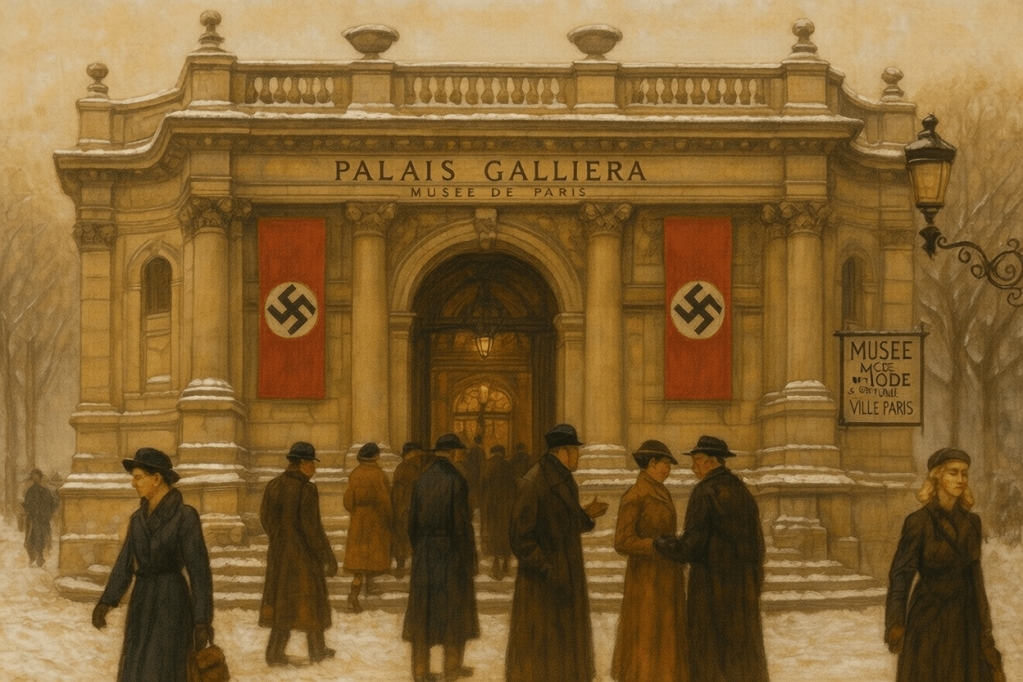
The fashion show was scheduled for November 15th, at the Palais Galliera, sponsored by German occupation authorities and featuring French designers who’d chosen cooperation over closure. The invitation list included Wehrmacht officers, Vichy officials, German industrialists’ wives, and carefully selected French society figures who wanted to demonstrate that Paris remained Paris even under swastikas.
Colette was listed as one of the featured models.
“It’s propaganda,” Marcel said when we met to discuss it, this time in a storage room behind a printer’s shop in the 15th that printed German occupation notices and therefore had reason for people coming and going at odd hours. “She’s legitimizing occupation. Making it look civilized.”
“She’s surviving,” I corrected. “And gathering intelligence. She’ll see who’s there. Who’s comfortable with Germans. Which French are collaborating openly.”
“That’s not worth the cost to her soul.”
“Maybe not. But that’s her choice to make.”
We’d been having versions of this argument for weeks. Marcel saw cooperation—even false cooperation—as betrayal. I saw it as tactics. Neither of us was wrong. Neither of us was right.
The war had made morality into arithmetic, and none of us knew how to calculate correctly.
I didn’t attend the fashion show. Too visible, too connected to the industry, too likely to be noticed by Weber or his people. But Lucien went, posing as an art critic covering cultural events for a small journal that paid him occasionally for reviews. He stood in the back, took notes, sketched quick impressions of the crowd.
He came to the printer’s storage room two days later, looking older and more tired than I’d seen him.
“It was obscene,” he said without preamble. “German officers and their wives sitting in the front row. Vichy officials preening. French designers showing collections like nothing had changed. And Colette—” He stopped. “She was perfect. Beautiful and smiling and gracious. Wore German-approved designs. Made polite conversation with officers during the reception. Played the role flawlessly.”
“That’s what she’s supposed to do,” Élise said.
“I know. But watching her do it—” He shook his head. “It looked real. That’s what terrified me. It looked like she actually enjoyed it. Like she’d become what she was pretending to be.”
“She hasn’t,” I said, though I wasn’t entirely certain.
“How do you know? How does she know? Where’s the line between pretending to collaborate and actually collaborating? Between playing a role and becoming it?”
No one answered. Because none of us knew.
Winter came early that year, bringing cold that settled over Paris like occupation itself—inescapable, grinding, making everything harder. Coal was rationed. Food was scarce. The Germans requisitioned buildings for their own use, displacing French families who had nowhere else to go.
And we continued our work, such as it was. Marcel stitched codes into the linings of coats for German officers’ wives, embedding intelligence about troop movements overheard during fittings. Élise developed formulas that looked like perfume samples but contained compounds that could reveal hidden inks or corrode documents slowly over weeks. Lucien painted safe, boring pictures and attended galleries where German officers discussed art and, occasionally, military matters they thought no one was listening to.
I maintained my cover as an importer, though importing had become nearly impossible with borders closed and shipping restricted. I met with German procurement officers, discussed fabric contracts that would never be fulfilled, smiled and nodded and played the role of boring English businessman who cared more about commerce than politics.
And all of us sent intelligence to London when we could, through methods that grew increasingly dangerous as German security tightened. Dead drops. Coded messages hidden in legitimate correspondence. Occasionally, when absolutely necessary, face-to-face meetings with contacts whose names we didn’t know and wouldn’t remember if arrested.
It wasn’t glorious. It wasn’t heroic. It was grinding, daily, careful work that accomplished small things and cost everything.
The call came in late November, just as the first snow began to fall.
Not a call exactly—a message left at the printer’s shop, written in handwriting I recognised as Hartmann’s:
Weber has discovered my involvement. He hasn’t arrested me yet—political complications, my family connections—but I’m being transferred. Eastern Front. Punishment disguised as duty. This is my last warning: he’s planning a sweep. Multiple arrests. Before Christmas. Anyone connected to British intelligence, art galleries, fashion industry networks. Dozens of people. He’s been building cases for months. Catherine gave him the first name. Others have given him more. Get out if you can. If you can’t, hide deeper than you’ve ever hidden. —K.H.
I burnt the note immediately, but the words remained.
Before Christmas. Multiple arrests. Dozens of people.
We met that night—all of us, together, for the first time in weeks—in the empty apartment in the 11th. It was too dangerous, too visible, but Hartmann’s warning demanded immediate coordination.
“We can’t all run,” Marcel said. “Too visible. Too suspicious.”
“We can’t all stay,” Lucien countered. “If Weber’s planning a sweep, anyone connected to galleries or fashion or British agents is a target.”
“That’s all of us,” Élise said quietly.
“Yes.”
We sat in silence, calculating odds, considering options, knowing that whatever we chose would cost someone everything.
“I have to stay,” Colette said finally. “If I disappear now, after modeling their show, after having breakfast with Weber—it proves I was hiding something. It puts everyone I’ve ever spoken to under suspicion.”
“You’ll be arrested,” Lucien said.
“Maybe. Or maybe I’m too visible now. Too useful as propaganda. Too connected to German approval to arrest without creating problems.” She paused. “I’m gambling that cooperation—false cooperation—has made me too valuable to touch.”
“That’s not a bet I’d take,” Marcel said.
“Good thing it’s not your bet to make.”
I looked at each of them, these people who’d become a cell through accident and necessity, and tried to calculate who could leave and who had to stay. Who was most at risk and who was most valuable. Who we could afford to lose and who we couldn’t survive without.
The arithmetic of resistance. The cost we’d been paying all along.
“Marcel,” I said finally. “You can leave. Close your shop. Claim you’re visiting family in the south. Use Véronique’s papers if you need to. You’ve been careful—you’re probably not on Weber’s list.”
“Probably isn’t certainly.”
“Nothing is certain. But you have the best chance of getting out safely.”
He considered this, his face unreadable. Then: “No. I’m staying. My shop, my work, my clients—they’re my cover. Leaving breaks that cover. Makes me suspicious. I stay.”
“Élise?” I turned to her.
“I can’t leave. Father needs me. The perfume lab needs me. And—” She paused. “And if I run, Bernard becomes an easy target. Weber will pressure him to find me. I stay to protect him.”
“Lucien?”
“My nephew is being watched because of me. If I flee, Antoine becomes a target.” He looked at me. “I stay.”
I’d known they would. All of them. Because leaving meant abandoning cover, abandoning people, abandoning the work. Because resistance wasn’t just about fighting—it was about remaining. Being present. Refusing to disappear.
Even when disappearing would be smarter.
Even when staying meant arrest.
Even when the cost became unpayable.
“Then we prepare for the sweep,” I said. “Destroy everything incriminating. Move everything sensitive. Create alibis and cover stories. And—” I looked at each of them. “—we accept that some of us might not survive Christmas.”
The sweep began on December 10th.
I wasn’t arrested. Neither was Marcel or Élise or Lucien or Colette. We’d been careful, compartmentalized, protected by covers that held under scrutiny.
But dozens of others weren’t as fortunate.
Gallery owners across Paris. Fashion house staff. Perfume distributors. People who’d facilitated meetings or passed messages or simply knew too many foreigners. Weber had been building his cases for months, using Catherine’s initial confession to map networks, following threads, being methodical and patient and absolutely thorough.
The arrests continued for a week. Each day brought news of more people taken to Avenue Foch. Each night brought the sound of trucks moving through dark streets, carrying prisoners to prisons or deportation or executions.
Paris learnt to look away. To not notice. To survive by seeing nothing.
And I stood on the narrow balcony of my boarding house in the 20th arrondissement, looking out at a city under snow and occupation, and prayed prayers that felt increasingly futile.
Keep them alive. Keep them strong. Don’t let the darkness win.
Show me how this serves your purposes.
Show me how cost becomes meaning.
But the only answer was silence and snow and the distant sound of German trucks rolling through occupied Paris.
I didn’t see Hartmann before he left. He was transferred quietly, efficiently, shipped east towards a front where German soldiers were discovering that Russia was larger and colder and more determined than they’d expected.
His last message arrived through the wine merchant, delivered by the cousin who asked no questions:
I tried to help. I failed more than I succeeded. But I tried. Tell Lucien his paintings are beautiful. Tell Colette she’s braver than she knows. Tell Miles that choosing beauty over ugliness matters, even when beauty loses. Especially then. —K.H.
I burnt it like I’d burnt all his messages. Then I went to a church in the 18th arrondissement—empty and cold, smelling of incense and stone—and sat alone in a pew, trying to pray, trying to understand.
Hartmann was gone. Probably to die in Russia, like thousands of other German soldiers who’d been sent east as punishment or duty or the grinding requirements of war.
The Hartmann Problem—the man who loved beauty but served ugliness—had been solved by removing him from the equation.
It didn’t feel like a solution. It felt like loss.
Christmas came quietly to occupied Paris. No celebrations. No joy. Just the mechanical observation of a holiday that felt increasingly irrelevant in a city where Germans celebrated and French endured.
We didn’t meet as a cell. Too dangerous after the sweep. Too visible. Too likely to draw attention when Weber was still processing arrests and building new cases.
But on Christmas Eve, a small package arrived at my boarding house, delivered by a street child who vanished before I could ask questions.
Inside was a bottle of perfume. No label. Just glass and scent.
And a note in Élise’s careful hand:
Number 17. The formula you asked about last summer. It reveals hidden messages under heat. Also: it smells like hope. Merry Christmas. We’re still here. —É.
I held the bottle, feeling its weight, smelling roses and something else—something sharp and clean and impossible to name.
Hope, Élise had said. It smells like hope.
I didn’t know if I believed that. But I kept the bottle anyway, hiding it with my false papers and Rupert’s letters and all the other things that could get me killed if discovered.
Because if hope was a scent, then maybe resistance was a perfume. Something you wore even when no one could see it. Something that lingered even after you were gone.
Something that persisted despite everything.
The year ended without ceremony. No fireworks. No celebrations. Just the quiet turning of days into weeks, weeks into months, occupation becoming normalized, resistance becoming routine.
We’d survived. Lost people. Paid costs. Watched networks collapse and friends disappear and the city we were trying to protect become something unrecognizable.
And we remained. Scattered and careful and calculating odds and costs and who we might save next time Weber came asking questions.
It wasn’t victory. It wasn’t even survival exactly. It was just—continuing. Refusing to stop. Being present in the darkness because absence would be surrender.
I received one more letter from Rupert that December, delivered on the last day of the year:
Miles,
Whatever you’ve lost—and I sense you’ve lost much—remember this: God’s economy doesn’t work like ours. In His arithmetic, the cost becomes the means. The sacrifice becomes the purpose. What we lose for Him is never wasted, even when we can’t see how it matters.
You’re being refined. That’s what this feels like. Not abandonment. Refinement. The dross burning away, leaving something purer behind.
I know that’s not comfort. But it’s truth. And sometimes truth is all we get until the fire stops burning.
Keep praying. Keep resisting. Keep being present in the darkness.
The Presslings are praying. I’m praying. And whether you feel it or not, God is holding you through this.
Happy New Year. May 1941 bring light you can’t yet see.
—R.
I read it on my narrow balcony, watching snow fall over occupied Paris, thinking about costs and purposes and whether anything we’d lost meant anything at all.
I still didn’t have faith. Not exactly. But I had something. A door opening. A heart softening. A sense that maybe—maybe—the darkness wasn’t winning. Just costing us everything whilst teaching us what everything meant.
It would have to be enough.
Because the war wasn’t ending. The occupation was tightening. Weber was building new cases. And we were still here, still working, still refusing to disappear.
Still paying costs we couldn’t afford for purposes we couldn’t see.
Still hoping that beauty—small, fragile, hidden beauty—mattered more than ugliness.
Even when ugliness kept winning.
Especially then.
 Lamp & Ledger