Collaborator
Episode 7: Collaborator
Paris, August—September 1940
…as remembered in London, October 1946
Antoine came back on a Tuesday.
I didn’t know he was free until I saw him standing outside the café on Rue de Buci where I’d been meeting a fabric supplier—legitimate business, documented, boring. He looked thinner, older somehow despite being gone only nine days. He wore the same clothes he’d been arrested in, and his hands shook slightly when he lit a cigarette, a habit I’d never seen him have before.
I’d been expecting my own arrest for weeks now—a British national in occupied Paris was living on borrowed time—but somehow my import business and Hartmann’s quiet interventions had kept me free. For now.
I finished my meeting, paid for weak coffee, and walked past him without acknowledgment. Three blocks later, in a narrow passage between buildings where the morning sun hadn’t yet reached, he caught up to me.
“They let me go,” he said quietly. “Yesterday morning. Just—let me go.”
“Why?”
“I don’t know. Weber questioned me for three days. Not torture, not really. Just—sitting in a room. Cold. No sleep. Questions about who I worked for, who I delivered to, what I carried. I told him I was freelance. Just packages. Commercial goods.” He drew on the cigarette with the desperate intensity of someone who’d been denied one. “He didn’t believe me. But he couldn’t prove anything. And then Hartmann came. I heard them arguing through the door. Hartmann said arresting couriers without evidence was inefficient. That I was more useful watched than imprisoned. That releasing me might reveal larger networks.”
“They’re going to follow you.”
“Yes.” He looked at me directly. “I’m bait, Miles. They released me to see who I contact. Where I go. Who trusts me enough to use me again.”
“Then we can’t.”
“I know.” He ground out the cigarette under his heel. “But I had to tell you. Had to warn you. They’re not guessing anymore. They’re mapping. Watching. They know there’s a network. They just don’t know who’s in it or what we’re doing.”
“Did you give them anything?”
“No. God—” He stopped, and something in his face told me the certainty I’d envied had been tested in ways I couldn’t imagine. “I prayed the whole time. Not for rescue. Just for strength. For the ability to keep silent. And He—” Antoine’s voice cracked slightly. “—He held me. I don’t know how else to say it. Every time I thought I’d break, every time Weber pushed, I felt—held. Not saved from it. But sustained through it.”
I thought about the prayers I’d attempted, awkward and faithless. Thought about Rupert’s letters about God’s presence in suffering. Thought about how different faith looked when it was tested rather than theorized.
“You should leave Paris,” I said. “Go back to Le Chambon. Stay with your family until this is over.”
“God is sovereign, Miles. Even over this.” He said it simply, without drama. “If He wants me here, I’m here. If He wants me to die, I’ll die. But I’m not running because Germans are watching.”
“That’s not courage. That’s stubbornness.”
“Maybe. But it’s also faith.” He looked up at the narrow strip of sky visible between buildings. “I know they’re watching. I know I can’t courier anymore. But I can still do something. Even if it’s just—being visible. Drawing their attention away from you. From the others.”
“That’s martyrdom.”
“No. Martyrdom is dying for something. This is living for something whilst knowing you might die.” He glanced back towards the street. “I have to go. They’ll wonder if I stand here too long. But Miles—be careful. They’re closer than we thought. And they’re patient.”
He walked away, back towards the sunlit street, and I watched him disappear into the morning crowd of Parisians learning to survive under occupation.
I didn’t follow. Didn’t contact him again. Didn’t acknowledge his existence.
Because he was right. He was bait. And the only way to keep the Germans from catching anything was to cut the line completely.
The cell met that night—what remained of it—in a new location: a storage attic above a wine merchant’s shop in the 5th arrondissement, accessed through a back staircase that smelt of cork and fermentation. Marcel had arranged it through a cousin who asked no questions and remembered nothing.
All of us came separately, at different times, using different routes. Marcel arrived first, then Lucien, then Élise. Bernard stayed away—too visible, too monitored after his near-arrest. Colette came last, wearing a headscarf and dowdy coat that made her look like a cleaning woman rather than a model.
I told them about Antoine. About the surveillance. About how the Germans were mapping networks without needing a collaborator.
“So there was no traitor,” Élise said quietly. “They were just watching.”
“Yes. Watching patterns. Courier routes. Who delivers where. Who meets whom. They’ve been building a map for months. Antoine’s arrest was them testing whether the map was accurate.”
“And Hartmann got him released,” Marcel said. “Why?”
“Because Hartmann understands that sometimes setting bait catches nothing but proves there’s something worth catching.” I looked at each of them. “They know we exist. They don’t know what we are or what we’re doing. But they know enough to keep watching.”
“Then we stop,” Lucien said. “We scatter completely. Wait for the surveillance to ease.”
“It won’t ease. Weber doesn’t forget. He’ll watch Antoine for months. Years if necessary. Waiting for one mistake. One contact. One proof that there’s something larger.”
“So Antoine sacrificed himself,” Colette said. “Drew their attention so we could keep working.”
“Yes.”
We sat in silence, in an attic that smelt of wine and old wood, considering what it meant that a nineteen-year-old boy had become a deliberate target to protect the rest of us.
“His faith held,” I said, surprising myself by mentioning it. “Under interrogation. He said he felt—held. By God. Not rescued, but sustained.”
Marcel crossed himself, an automatic gesture. Lucien looked away. Élise said nothing.
Colette studied me. “You sound almost envious.”
“Maybe I am. That certainty. That sense of being sustained by something larger than yourself.” I paused. “I’ve been reading theology. Letters from someone in London. A man who claims God makes appointments with people. Chooses them. Changes them whether they want it or not.”
“Do you believe it?” Élise asked.
“I don’t know. But I’m reading. Thinking. Praying, after a fashion. Which is more than I was doing six months ago.”
“War makes believers of everyone eventually,” Marcel said quietly. “Or it makes atheists. There’s not much middle ground in occupation.”
“Which are you?”
He smiled faintly. “I’m French. We’re Catholic by default and skeptical by nature. I light candles and hope someone’s listening. That’s as much faith as I can manage.”
The knock came three days later.
Not on my door. On Lucien’s studio in Montmartre. Two German soldiers and a French policeman, asking questions about his paintings, about his clients, about whether he knew a courier named Antoine Moreau.
Lucien told them the truth: Antoine was his nephew. Estranged. Hadn’t seen him in years. Different politics, different lives. The Germans searched anyway, found nothing incriminating, left after two hours of methodical inspection.
But they’d made their point. They were watching not just Antoine, but everyone connected to him. Mapping the family, the associates, the network of relationships that might hide something worth finding.
“They know about me,” Lucien said when we met two nights later, this time on a balcony behind a boarding house in the 14th arrondissement that Marcel had secured. Not the ample balcony of the Montalembert with its view of Notre-Dame—this was barely wide enough for two people, looking down on a garbage-strewn courtyard where cats fought and rain pooled. But it was outside, exposed to air and sky, and something in me needed that. Needed the feeling of space, of seeing horizon, even if the horizon was just darkened rooftops under German curfew.
“They searched your studio,” I said. “Did they find anything?”
“No. I stopped painting coded work months ago. Everything there is clean. But Miles—they asked specifically about Antoine. About whether I’d seen him. Whether he’d come to me after his release.” Lucien lit a cigarette, his hands steadier than Antoine’s had been but his face older, harder. “They know he’s my nephew. They know we’re connected. Which means they’ll keep watching me. Following me. Waiting to see if he makes contact.”
“He won’t.”
“I know. But that doesn’t matter. They’ve marked me now. The uncle of the suspicious courier. The painter whose work hangs in galleries where Germans drink champagne and discuss French culture like it’s something they own.”
“We can move you. False papers. Véronique—”
“Véronique is gone. Fled before the trap closed. Smart woman.” He drew on his cigarette. “No, I’m staying. Painting my safe, boring pictures. Attending my galleries. Being exactly what they expect: a French artist surviving occupation by being harmless.”
“While actually doing what?”
“Nothing. For now. Until they stop watching.” He glanced at me. “That’s the clever thing about releasing Antoine. It doesn’t just compromise him. It compromises everyone connected to him. His family. His associates. Anyone who might trust him. They’ve turned one arrest into a dozen surveillance targets.”
“Efficient,” I said bitterly.
“Yes. Weber is very good at his work.” He paused. “Have you heard from Colette? About her dinner with him?”
“She went last week. Said he was charming. Interested in her modeling career. Asked whether she’d consider working with German fashion houses. Establishing French-German cooperation in the luxury trades. All very civilized. Very proper.”
“And underneath?”
“Underneath, he’s circling. Testing. Seeing if she’s useful or dangerous or both.” I looked out at the dark courtyard, the rain-slicked cobblestones catching faint light from distant windows. “She’s playing a game with a man who invented the rules. Eventually, she’ll make a mistake. Or he’ll get impatient. Or both.”
“Can we extract her?”
“To where? London’s impossible now. Spain’s closed. Switzerland’s watching borders like hawks.” I shook my head. “She’s in it. Deep. And the only way out is through.”
We stood in silence, two men on a narrow balcony, looking at a city that had become a prison neither of us knew how to escape.
“What are you reading?” Lucien asked suddenly.
“What?”
“You mentioned theology. Letters from London. What are you reading?”
I thought about Rupert’s letters, now arriving monthly through channels I still didn’t understand. About the transcribed sermons on Romans. About the quiet, persistent voice suggesting that God was working through darkness without being darkened by it.
“Reformed theology. Calvinist. God’s sovereignty. Election. The idea that some people are chosen not because they deserve it but because—” I paused. “—because God makes appointments. Removes hearts of stone. Gives hearts of flesh instead.”
“Do you believe it?”
“I’m considering it. Which is more than I expected to do.”
“War changes us,” Lucien said. “Makes us into people we don’t recognise. Antoine came back from Avenue Foch different. Older. You’re different than you were last year. We’re all—” He stopped. “—becoming something we weren’t. Whether that’s good or bad, I don’t know yet.”
“Antoine says God is sovereign over all of it.”
“Antoine is nineteen and believes what he was told in a field seven years ago.” Lucien’s voice wasn’t cruel, just weary. “I’m forty and I’ve seen too much to believe in appointments. I believe in choices. In people doing what they can with what they have. In resistance that costs something.”
“That’s not incompatible with faith.”
“Maybe. But it’s enough without it.”
The woman arrived five days later.
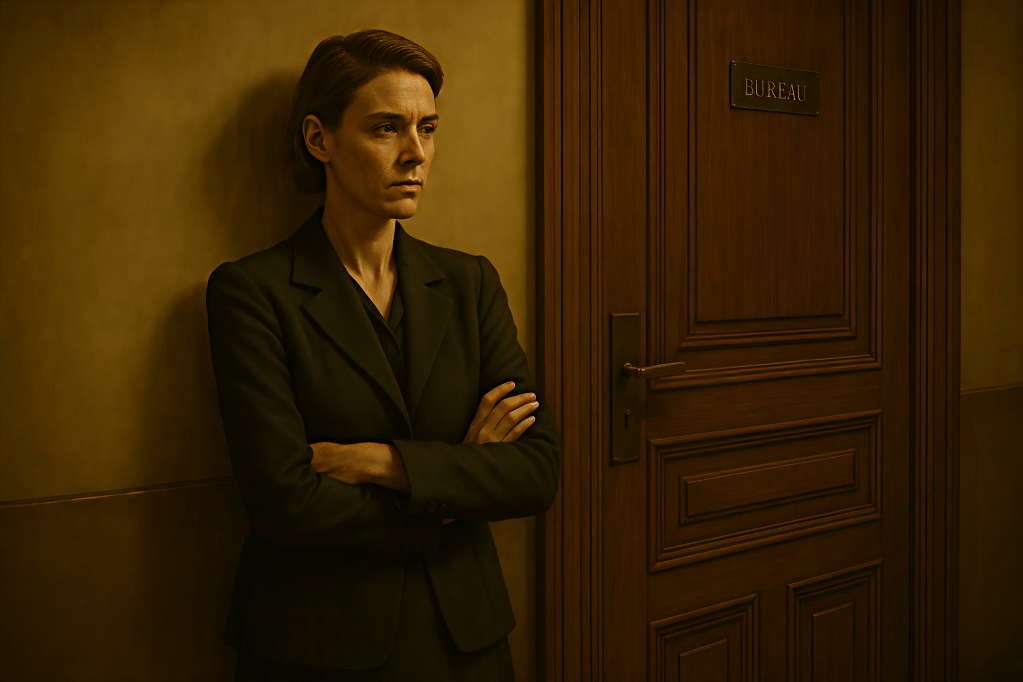
She found me at a legitimate meeting with a German procurement officer discussing fabric imports—tedious, documented, the kind of boring commerce that maintained my cover. When the meeting ended, she was waiting outside the office, leaning against the wall with the casual confidence of someone who belonged everywhere and nowhere.
She was perhaps thirty-two, lean and sharp-featured, with dark blonde hair cut shorter than was fashionable and eyes that assessed me in the two seconds it took to approach.
“Miles Penbury,” she said. Not a question.
“Yes.”
“Catherine Wells. London sent me. We should talk.”
We walked to a café three blocks away, said nothing until coffee arrived, waited until the German officers at the next table finished their conversation and left.
“You’re British intelligence,” I said quietly.
“Obviously. Pemberton said you’d need support. That your network was compromised. That you’d lost your courier.”
“We lost Antoine to surveillance. He’s bait now. Watched constantly.”
“So I heard. Unfortunate.” She stirred her coffee with the indifference of someone discussing weather rather than human catastrophe. “But that’s why I’m here. Fresh face. No connections to your cell. Clean papers. I can move where you can’t.”
“What’s your cover?”
“American journalist. Freelance. Writing about life in occupied Paris. The human interest angle. Germans love it—makes the occupation look civilized. Gives me access to places you can’t go.”
“Where are you staying?”
“Hotel in the 9th. Nothing fancy. Cheap enough to be believable for a freelancer.” She sipped her coffee. “I’ve been briefed on your operation. Fashion, art, perfume as cover for intelligence gathering. Very clever. Very slow.”
“Slow keeps us alive.”
“Slow also keeps you useless.” She leant forward. “Pemberton sent me because London needs actionable intelligence. Troop movements. Supply routes. Command structure. The kind of information that wins wars, not the gossip you get from fashion shows.”
“The gossip is intelligence. Who’s collaborating. Which businesses are working with Germans. Where money’s flowing. That matters.”
“Maybe. But it doesn’t stop tanks.” She pulled out a cigarette, lit it without asking permission. “I’m here to accelerate things. Take risks you’re too careful to take. Get information that actually moves needles.”
“You’ll get caught.”
“Possibly. But I’ll get something useful first.” She smiled without warmth. “That’s the difference between us, Miles. You’re trying to survive the war. I’m trying to win it.”
I wanted to argue. To explain that survival was itself a form of resistance. That staying alive and functional and gathering intelligence—even slow intelligence—was valuable. That recklessness got people killed and networks destroyed.
But I looked at her and saw something I recognised: someone who’d decided dying mattered less than making a difference. Someone who’d calculated the odds and accepted them. Someone dangerous not because she was brave but because she didn’t particularly care whether she lived.
“What do you need from me?” I asked.
“Contacts. Introductions to your network. Access to whatever resources you’ve built.”
“No.”
“Excuse me?”
“You’re not meeting my network. You’re not accessing my resources. You work parallel, not integrated. If you get caught—when you get caught—you don’t take us with you.”
Her eyes hardened. “That’s not how Pemberton described this arrangement.”
“Then Pemberton doesn’t understand how occupation works. You’re here, fine. You’re operating, fine. But you operate separately. We’ll share intelligence if we find something worth sharing. But you don’t meet Marcel. You don’t meet Colette. You don’t meet anyone whose name you could give up under interrogation.”
“I wouldn’t talk.”
“Everyone talks. Weber doesn’t use thumbscrews and racks. He uses isolation and deprivation and time. He’s patient. And eventually, everyone breaks.”
“You sound afraid.”
“I’m careful. There’s a difference.”
She studied me for a long moment, then shrugged. “Fine. Parallel operation. But when I get something big—and I will—don’t expect me to wait for your permission to act on it.”
“Just don’t get my people killed in the process.”
“No promises, darling.” She stood, dropped coins on the table. “I’ll be in touch when I have something worth sharing. Try not to die of boredom in the meantime.”
She left before I could respond, disappearing into the afternoon crowd of Germans and French moving through occupied Paris.
I sat alone, drinking cold coffee, thinking about how she was going to get someone killed.
Possibly herself.
Possibly all of us.
September arrived with rain that fell for days, turning Paris grey and sodden. The city smelt of wet stone and coal smoke and the particular melancholy of autumn coming early. The Germans consolidated their control: more checkpoints, more papers, more rules about who could be where and when.
And we adapted. Marcel reopened his shop, taking German officers’ wives as clients, stitching their measurements into ledgers whilst listening to them talk about their husbands’ duties, their frustrations, their gossip. Élise continued her work at Parfums Garnier, developing formulas under German supervision, hiding her real work in plain sight. Lucien painted safe pictures and attended galleries where Wehrmacht officers bought art to send home as proof of their civilized occupation.
Colette saw Weber twice more. Dinner once. A gallery opening the second time. Both times she returned to report the same thing: he was interested, suspicious, circling closer, testing whether she was ally or enemy or simply someone beautiful who could be useful.
“He asked about you,” she told me at one of our rare meetings, this time in a church in the 7th arrondissement where we pretended to pray whilst actually talking in whispers. “By name. Asked if I knew an English importer. Miles Penbury. Said he’d heard I’d modeled for buyers from London.”
“What did you say?”
“That I knew the name. That you bought from Schiaparelli occasionally. That you were boring and commercial and cared more about fabric quality than fashion.” She paused. “He didn’t believe me. Or rather, he believed it but thought there was more. He’s building a picture, Miles. Connecting dots. You, me, the fashion world, the galleries. He doesn’t know what it means yet. But he’s getting closer.”
“How much longer can you maintain this?”
“I don’t know. He wants me to work for him. Officially. Report on people in the fashion industry. Who’s resistant, who’s cooperative, who might be useful. He’s offering money. Protection. The illusion of safety.”
“Will you say yes?”
“I don’t know.” She looked at the altar, at the crucified Christ hanging in suffering stillness. “If I say no, he’ll suspect I’m hiding something. If I say yes, I become what I’ve been pretending to be. Actually working for Gestapo. Actually betraying people.”
“You could give him real collaborators. People who are actually helping Germans.”
“That’s still betrayal.”
“Of people who betrayed France first.”
“Maybe.” She stood, adjusting her headscarf. “But where does it stop? Today I give him names of collaborators. Tomorrow he asks for names of resisters. And eventually I’ll give him those too, because the alternative is Avenue Foch and Weber’s patient questions and isolation until I break.”
“Then leave. Hide. Use the false papers Véronique made.”
“And go where? Become someone else? Live the rest of my life as—” She stopped. “No. I’m staying. Playing the game. Hoping I can play it longer than Weber can wait.”
“That’s not a strategy. That’s a gamble.”
“Everything is a gamble now, Miles. The only question is what we’re gambling for.”
She left through the side entrance, and I remained alone in the church, looking at the suffering Christ, wondering if Antoine’s God who sustained through darkness was the same one who let that darkness exist in the first place.
A letter from Rupert arrived two days later, delivered to my shabby hotel through the mysterious channels that had been working all summer:
Miles,
I’ve been praying for you. For your friends. For all of it.
Here’s what I keep coming back to: God doesn’t promise to prevent suffering. He promises to be present in it. Not as explanation but as companionship. Not as rescuer but as sustainer.
Perhaps, you’re beginning to understand it. The question isn’t whether God exists—He does. The question is whether you’ll trust Him when He doesn’t perform according to your expectations.
Sovereignty doesn’t mean God prevents every tragedy. It means He works through them. Uses them. Transforms them into something that serves His purposes even when we can’t see how.
That’s not comfort, exactly. But it’s truth. And sometimes truth is all we get.
Keep reading Romans. Especially chapter 8, verses 28-39. Nothing—nothing—separates us from His love. Not even strife. Not even your doubt.
—R.
P.S. The Presslings ask about you when we meet. They’re praying too. You’re not alone, even when it feels that way.
I read it three times, then hid it with the others, a growing collection of theology and pastoral care from a man I’d met once and corresponded with invisibly. I didn’t know who the Presslings were—some prayer group of Rupert’s, perhaps—but the notion of strangers in London praying for me felt less foolish than it would have six months ago.
I didn’t believe it all. But I kept reading. Kept considering. Kept having conversations with a God I wasn’t sure existed about situations I couldn’t control.
It wasn’t faith. But it was something. A door opening slowly. A heart of stone beginning to crack.
Catherine Wells lasted three weeks.
I didn’t know what she’d been doing—she’d kept her word about operating separately—but on September 24th, she sent an urgent message through a café waiter: Found something big. German supply depot. Meeting location tonight. Bring no one.
I went to the location: a wine cellar in the 18th arrondissement, accessed through a restaurant that had closed months earlier. The door was unlocked. The stairs descended into darkness that smelt of mildew and old bottles.
I found her in the cellar, sitting on a crate, smoking calmly.
“There’s a supply depot in the 19th,” she said without preamble. “Weapons, ammunition, medical supplies for eastern front. Lightly guarded because it’s supposed to be secret. I’ve mapped the schedule. Guards change at midnight. There’s a fifteen-minute window.”
“For what?”
“Sabotage. Fire, explosion, something that disrupts their supply chain. Shows them we’re not just passive. That occupation has costs.”
“That’s suicide.”
“It’s necessary.” She stood. “I have explosives. Timers. A plan that works. I need someone to create a distraction on the other side of the compound. Draw guards away for five minutes. That’s all.”
“No.”
“Miles—”
“No. You sabotage that depot, they’ll retaliate. Round up hundreds of French civilians. Execute them in reprisal. Turn this into a bloodbath that accomplishes nothing except making Weber tighten control.”
“So we do nothing? Just watch them stockpile weapons?”
“We report it to London. Let RAF bomb it if they want. But we don’t sacrifice French civilians for British objectives.”
“You’re a coward.”
“I’m realistic. And I’m not helping you commit massacre disguised as resistance.”
She stared at me, and in her eyes I saw the calculation: whether to try convincing me, threatening me, or simply proceeding without me.
“Fine,” she said finally. “I’ll do it myself. Alone. And when it works, when we show that resistance is possible, maybe you’ll stop being so damn careful.”
“Catherine—”
“Stay out of my way, Miles. I’m done asking permission.”
She walked past me, up the stairs, out into the night.
I stood in the wine cellar, surrounded by empty bottles and darkness, knowing I should stop her. Knowing I couldn’t. Knowing that in three days or three weeks she’d be caught and interrogated and killed, and there was nothing I could do to prevent it.
I thought about praying. About asking Antoine’s sovereign God to protect a woman too reckless to protect herself.
But the prayer wouldn’t come. Only the certainty that we’d just lost someone, even if she didn’t know it yet.
The call came from Hartmann four days later. Not to me directly—that would be too visible. But through a note left at the wine merchant’s shop where we’d been meeting: The journalist has been arrested. Weber has her. She hasn’t talked yet but will. Burn everything. Move everyone. Do it tonight. —K.H.
We scattered within hours. Marcel closed his shop, claimed illness, moved to his cousin’s flat in the suburbs. Lucien left his studio, temporarily relocated to a painter’s colony in Fontainebleau that asked no questions. Élise continued working at Parfums Garnier—too visible to disappear without raising suspicion—but moved everything sensitive out of her lab.
And I changed hotels again, this time to a boarding house in the 20th arrondissement that rented rooms by the night and recorded nothing in ledgers.
We didn’t meet for two weeks. Communicated only through dead drops: messages left in agreed locations, picked up hours later, destroyed immediately. Short, coded notes about safety, about status, about the constant fear that Catherine would break and give Weber everything.
I received another letter from Rupert during this time, brief and somehow exactly what I needed:
Miles,
Whatever is happening—and I can sense from your silence that it’s bad—remember: God holds you even when you can’t feel Him holding. Especially then.
Psalm 139: Where can I flee from Your presence? If I go up to the heavens, You are there. If I make my bed in the depths, You are there.
Even in Paris. Even in occupation. Even in the moment you think He’s abandoned you.
He hasn’t. He won’t. He can’t. That’s what sovereignty means.
—R.
I kept the letter in my jacket pocket, touching it occasionally like a talisman against despair.
And late at night, alone in my rented room with its single window overlooking an alley where rats fought over garbage, I prayed. Still without faith. Still without certainty. But with something that might, eventually, become both.
Keep her alive, I prayed to Antoine’s God. Don’t let her break. Don’t let this destroy what we’ve built.
And if you’re real—if you’re sovereign over all of this—please, please show me how darkness serves your purposes.
Because from where I’m standing, it just looks like darkness winning.
The only answer was silence and the sound of rain on windows and the distant rumble of German trucks moving through occupied Paris.
But I kept praying anyway.
And somewhere in London, Rupert Brimble and the Presslings kept praying too.
It would have to be enough.
Because it was all we had left.
 Lamp & Ledger