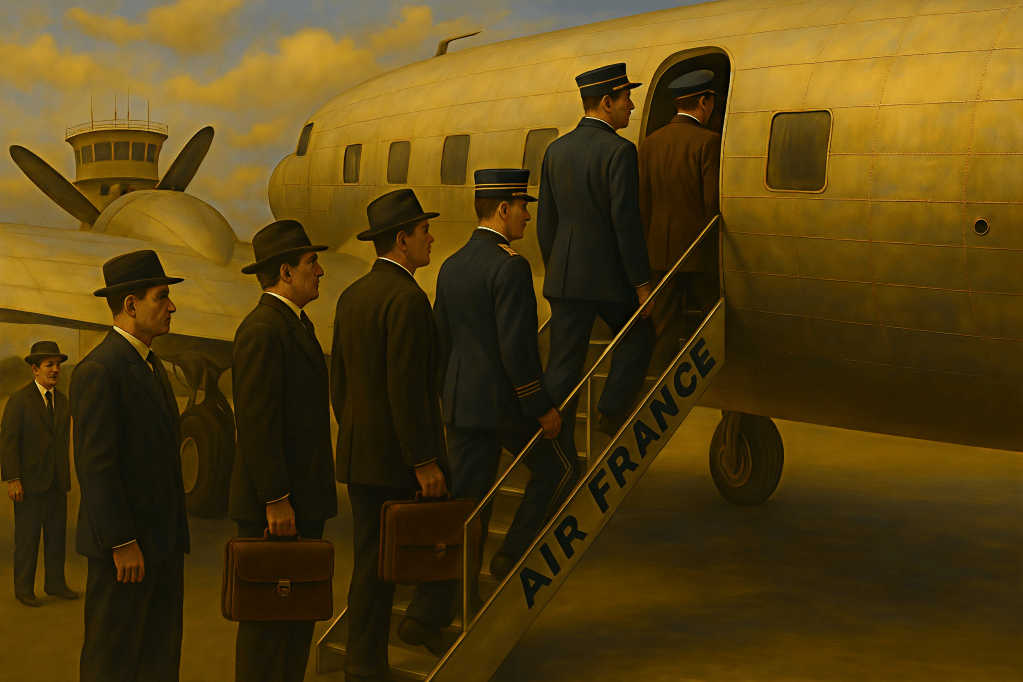
The Fall
Episode 5: The Fall
London / Paris, November 1939-July 1940
…as remembered in London, October 1946
The winter of 1939 was the coldest I can remember, though perhaps memory makes it colder than it was. The kind of cold that settles into buildings and bones and doesn’t leave even when spring finally comes. The British called it the Phoney War; the French, drôle de guerre—as if giving it different names would make it less real. As if we could laugh at the absurdity of armies facing each other across borders, waiting, not fighting, preparing for violence that everyone knew was coming but no one wanted to begin.
The months between October and May felt suspended, neither peace nor war but something in between. Paris tried to pretend. The theaters stayed open. The cafés served watered wine and called it patriotic rationing. The fashion houses prepared spring collections for women who might not live to wear them. And we worked, quietly, in the spaces between what Paris was and what it was about to become.
I travelled less that winter. The borders were difficult, the questions more pointed, the scrutiny more intense. But I made three trips to London between November and March, carrying messages stitched into jacket linings and shipping manifests that contained intelligence about German industrial movements, about which French businesses were preparing to collaborate, about the machinery of occupation being assembled in Berlin.
Pemberton grew grayer each time I saw him. His office, which had once smelt of pipe tobacco and old paper, now smelt of something else. Fear, perhaps. Or exhaustion.
“How much longer?” he asked in February, pouring whisky that was too good for the conversation we were having.
“Weeks. Maybe days. The spring offensive will come through Belgium and the Netherlands. Around the Maginot Line. It’s what we’ve been saying for months.”
“We know. Churchill knows. Everyone knows.” He drank. “But knowing and preventing are different things.”
“Will you evacuate me when it happens?”
He was quiet for a long time. “Do you want to be evacuated?”
“I’m asking if I should be.”
“That’s not the same question, Penbury.” He looked at me over his glass. “You’re useful where you are. You have networks, contacts, cover that will survive occupation. If you leave now, we lose all of that. But if you stay—” He stopped.
“If I stay, I might not survive to be useful.”
“Yes.”
We sat in silence, two Englishmen drinking whisky in an office near Westminster whilst Europe prepared to burn.
“I’ll stay,” I said. “For now. Until staying becomes dying.”
“How will you know the difference?”
“I suppose I won’t. Not until it’s too late.”
He nodded, unsurprised. “Then be careful. And if you need extraction, send the signal. We’ll do what we can.”
“Will you?”
“Probably not. But we’ll try.”
It was the most honest thing anyone had said to me in months.
The offensive began on May 10th, just as Colette had predicted six months earlier.
Belgium. The Netherlands. Luxembourg. The Germans came through the north in a mechanized wave that made the previous war look like a medieval siege. Tanks and aircraft and coordination that shattered the Allied lines in days.
We gathered in Lucien’s studio on May 12th, listening to radio reports that grew more desperate by the hour. The government was preparing to evacuate. The roads south were clogged with refugees. The hospitals were filling with wounded from battles that hadn’t even reached France yet.
“How long?” Élise asked.
“Three weeks,” Marcel said. “Maybe four. Then they’ll be here.”
“What do we do?”
“We survive. We hide what needs hiding. We prepare to work under occupation.” He looked at each of us. “And we decide now—tonight—who stays and who goes.”
“I’m staying,” Antoine said immediately. “This is my country.”
“You’re nineteen,” Lucien told his nephew. “You could leave. Get to Spain, to England. Fight from there.”
“I can fight from here.”
“You can die from here.”
Antoine met his uncle’s eyes. “Then I’ll die. But I’m not running.”
It was said with such simple certainty that no one argued. In the months I’d worked with Antoine, I’d learnt that he possessed something the rest of us lacked: an absolute conviction that certain things were right and certain things were wrong, and that choosing right mattered regardless of cost. He’d grown up in Le Chambon-sur-Lignon, a Protestant village in the Cévennes that had been sheltering religious refugees since the 1600s. His parents had taught him to help people. His village had taught him that resistance to evil was not optional.
And something else—something he rarely spoke about but that shaped everything he did. At thirteen, working in a field outside his village, he’d had what he could only describe as an encounter. With God, he said, though he couldn’t explain what that meant. Just that one moment he’d been alone, and the next he’d known, with certainty that defied explanation, that God was real and had chosen him for something.
His parents thought it was their teaching finally taking root. Antoine knew better. “They gave me common grace,” he’d said once, in one of our late-night conversations. “Morality, kindness, all that. But this—” He’d gestured vaguely. —”this was different. This was God doing something they couldn’t do. Something I couldn’t do to myself.”
I’d found it unsettling, that certainty. That claim to knowledge without evidence. But watching him now, volunteering to stay in a city that was about to become a prison, I envied it. To know, without needing to understand. To be certain when certainty was impossible.
I had no such certainty about anything.
The Germans were closing in on Paris. On June 10, the government fled to Tours, then Bordeaux. Three days later, the city was declared open—undefended, surrendered without a fight to preserve its architecture and art. A practical decision. A devastating one.
I stood on my balcony at the Montalembert on the evening of June 13th, watching the last light fade over Notre-Dame, and thought about God for the first time in years.
Not prayer. Not belief. Just the question that had been forming since winter: If there was a God who saw everything, who supposedly cared about justice and mercy and the suffering of the innocent, where was He now? Where was He when the armies rolled through Europe? Where was He when children died in bombed-out streets? Where was He when evil won and good people prepared to die resisting it?
The silence from heaven felt like answer enough.
Marcel found me there, smoking, watching the city prepare for occupation.
“They’ll be here tomorrow,” he said. “Or the next day.”
“I know.”
“We should move the operations completely. No more meetings at my shop, no more using your hotel. Everything underground from now on.”
“Agreed.”
He was quiet for a moment, then: “Do you pray, Miles?”
The question surprised me. Marcel was Catholic the way most French were Catholic—culturally, historically, a matter of identity rather than conviction. I’d never heard him discuss faith.
“No,” I said. “Do you?”
“Sometimes. Old habit. Mostly I light candles for the dead.” He paused. “My mother believed. Really believed. She said God watched everything. That He knew every sparrow that fell.”
“And you?”
“I think if God is watching sparrows fall, He’s doing a damn poor job of catching them.” He said it without bitterness, just weariness. “But I still light the candles. Just in case.”
“In case of what?”
“In case she was right. In case He’s listening. In case—” He stopped. “I don’t know. In case it matters.”
I thought about Antoine, about his certainty. About Élise, who’d never mentioned God at all. About Bernard, Jewish by birth but secular by choice, who’d told me once that if God existed, He’d abandoned His people in Germany years ago.
“If there’s a God,” I said quietly, “and He’s watching this—watching what’s about to happen to this city, to France, to all of it—then either He can’t stop it or He won’t. I’m not sure which is worse.”
Marcel lit a cigarette, the match flaring briefly in the darkness. “Maybe it’s neither. Maybe He’s just waiting.”
“For what?”
“For us to do what needs doing. For sparrows to learn to fly.”
It was the most theological thing I’d ever heard him say. It was also completely unsatisfying.
We stood there until the cold drove us inside, two men on a balcony, watching a city fall without a shot fired.
The Germans entered Paris on June 14th, 1940.
I watched them from my hotel window: columns of soldiers in field grey, marching down the Champs-Élysées with the precision of a parade. Staff cars. Motorcycles. Officers who looked like they were on holiday rather than conquering a nation. The swastika flags went up over government buildings. The clocks were changed to Berlin time. And Paris, beautiful and helpless, became a German city.
We didn’t meet for three days. Too dangerous, too visible. But on June 17th, Marcel sent word through Antoine: emergency meeting. Lucien’s studio. Everyone.
When I arrived, climbing the five flights through the now-closed bakery, I found them already gathered. And with them, someone I hadn’t seen since she left for Berlin a year ago.
Colette.
She sat in the corner, wrapped in a coat despite the June heat, her face thinner and harder than I remembered. Her hair was different—shorter, darker. She looked like someone who’d learnt to become invisible by disappearing into plainness.
Her eyes moved across the room as I entered—Marcel, Lucien, Élise, me. Then stopped on the young man by the window. A stranger.
“Who’s he?” she asked, her voice flat, careful.
“My nephew,” Lucien said. “Antoine. He joined after you left. He’s—”
“A courier,” Antoine finished. He didn’t move from the window, watching her with the cautious curiosity of someone meeting a legend he’d only heard about. “I’ve heard about you. About Berlin. About the intelligence you sent.”
Colette studied him for a moment—assessing, calculating, the way she’d learnt to assess everyone in the past year. Finally, she nodded once. “Then you know more about me than I know about you.”
“Jesus,” Lucien whispered, looking at Colette properly now. “Colette—”
“Don’t,” she said quietly, still watching Antoine. “Don’t ask questions yet. Just listen.”
She’d returned two days ago, slipping across the border from Belgium in the chaos of the refugee exodus. She’d been in Berlin until May, working—sleeping with, she said bluntly—Richter’s assistant and feeding information to British contacts when she could. Then Weber had appeared, had begun asking questions, had started watching her with the focused attention of a man who suspected something but couldn’t prove it.
“He knew,” she said. “Or suspected. I don’t know how much. But in late April, he told me he wanted me to return to Paris. To continue my modeling work. To be his eyes and ears in the fashion world when the occupation came.” She paused. “He gave me a list of names. People to watch. People to report on.”
“Were we on it?” I asked.
“Yes. All of you. Marcel’s shop. Lucien’s studio. Élise’s perfume lab. Even the Galerie Rousseau.” She glanced at Antoine, something shifting in her expression. “There was another name I didn’t recognize when I saw the list. Antoine Moreau. Marked as a courier with questionable delivery patterns. I didn’t know who that was then.” She paused. “Now I do. You’re not connected to anything specific yet in their files—that’s why you’re still valuable. You’re invisible to them.”
“For now,” Marcel said quietly.
“For now,” Colette agreed. “But Weber is patient. He’ll keep watching. Keep building cases. Eventually, everyone on his watch list either makes the arrest list or proves themselves innocent.” She looked back at Antoine. “Be more careful than you’ve ever been. Because you’re not invisible forever.”
She turned to me. “You weren’t on the list, Miles. Which means either he doesn’t suspect you, or he’s watching you differently.”
“The engagement,” Élise said. “The photograph. Was that real?”
“No. Performance. Propaganda. Weber wanted it known that a French model was cooperating, was willing to—” She stopped. “It wasn’t real. But it had to look real. And I had to leave before it became something I couldn’t escape.”
“How did you get out?” Marcel asked.
“Hartmann.” She said it simply. “He arranged papers. Transit documents. He said Weber was getting too close, that I needed to leave whilst leaving was still possible. He said—” She paused. —”he said to tell you he’s been posted to Paris. Cultural Affairs. He’ll be at the Hôtel Meurice. And he said: ‘The paintings remember everything.’”
We sat in silence, processing what that meant.
Hartmann, who’d bought Lucien’s coded paintings. Hartmann, who’d warned us to prepare. Hartmann, who was now in Paris, in uniform, in a position to either protect us or destroy us.
“Can we trust him?” Antoine asked. It was the first real question he’d posed since she’d arrived—speaking to her directly now, as if her story about Berlin had earned him the right. Marcel had told him about the model in Berlin, the one who’d been gathering intelligence at extraordinary risk. But hearing it was different from seeing her: thin, hard, older than her twenty-seven years.
“I don’t know,” Colette admitted. “But he got me out. That has to count for something.”
“Or it’s a long game,” Lucien said. “Establish trust, then spring the trap.”
“Maybe. But I’m here. I’m alive. And I have this.” She pulled a folded paper from her coat. “Weber’s complete list. Everyone he’s watching. Everyone he suspects. Everyone he plans to arrest once the occupation is established.”
She spread it on the worktable. Thirty, maybe forty names. Artists, writers, journalists, business owners. Jews and Communists and people whose only crime was being insufficiently enthusiastic about German rule.
And there, near the bottom: Bernard Garnier. Parfumeur. Suspected of harboring refugees. To be detained for interrogation.
Élise went pale. “Papa.”
“He’s not arrested yet,” Colette said quickly. “But he will be. Soon. Weber is methodical. He’ll work through this list systematically.”
“When?”
“Days. Maybe a week. The prisons are being reorganized. French prisoners transferred out, German authority established. Once that’s done—” She didn’t need to finish.
“We have to get him out,” Élise said. “Before they take him.”
“Out where?” Marcel asked. “The borders are closed. The south is flooded with refugees. Switzerland is sealed. Where do we hide a man the Gestapo is actively looking for?”
“We hide him in plain sight,” I said slowly. “We make him too valuable to arrest. We make the Germans need him.”
“How?”
I thought about Hartmann. About his love of Paris, his desire to preserve what was beautiful. About the words Colette had brought back: The paintings remember everything.
“We ask Hartmann for help,” I said.
It took three days to arrange the meeting. Three days of Antoine carrying messages through streets that were filling with German soldiers and French collaborators. Three days of Bernard hiding in Élise’s apartment, burning papers, destroying records, preparing for arrest or flight or whatever came next.
Finally, on June 20th, word came back: Hartmann would see me. Alone. At the Hôtel Meurice. His office, fourth floor, 2 PM.
I went carrying a leather portfolio that contained fabric samples and perfume contracts and all the ordinary business of an importer maintaining cover. But underneath, hidden in the lining, was Colette’s list. Weber’s list. The names of everyone he planned to destroy.
The Meurice had been transformed. Where once it had hosted wealthy tourists and Parisian society, it now housed German command. Officers moved through the lobby with the casual authority of conquerors. Secretaries typed. Telephones rang. The machinery of occupation humming efficiently.
Hartmann’s office was smaller than I’d expected: a converted hotel room with a desk, filing cabinets, and windows that looked out over the Tuileries. His rapid commission—student to Hauptmann in barely a year—wasn’t unusual for men with his credentials. The Wehrmacht was expanding Cultural Affairs offices across occupied territories, and they needed educated specialists who understood art, architecture, and the diplomatic nuances of preservation. University men with doctoral work and language skills were being fast-tracked into these positions. Hartmann’s Sorbonne pedigree made him ideal for Paris.
He stood when I entered, still in uniform, still wearing wire-rimmed glasses, still looking like someone who’d rather be reading Baudelaire than administering conquest.
“Monsieur Penbury.” He shook my hand. “It’s been a long time.”
“Over a year.”
“Yes. Much has changed.” He gestured to a chair. “Coffee? It’s real. One of the few privileges of occupation.”
“Thank you.”
He poured from a silver service that probably belonged to the hotel. We sat across from each other like businessmen discussing contracts, not two men who knew too much about each other’s secrets.
“You stayed,” he said. “I thought you might have evacuated.”
“I have business here.”
“Business.” He smiled faintly. “Yes. That’s one word for it.” He removed his glasses, cleaned them. “I helped Mademoiselle Marchand leave Berlin. Did she tell you?”
“She did.”
“Weber was becoming… interested. Too interested. I thought it best she return to Paris before questions became accusations.” He put his glasses back on. “She’s very brave. Or very foolish. Possibly both.”
“She said you remember the paintings.”
“I do. I have them still, in my apartment in Munich. I look at them when I need to remember why I’m doing this work.” He paused. “Preserving Paris. Protecting what’s beautiful. Trying to be the man who loved this city rather than the man who conquered it.”
“It’s not easy, I imagine.”
“No. It’s not.” He stood, walked to the window. “I have a problem, Monsieur Penbury. My commanding officer believes in efficiency. In control. In making examples. He’s Gestapo, transferred from Poland, and he has… strong opinions about how occupation should be administered.”
“Weber.”
“Yes.” He turned. “You know about him.”
“We know he has a list. People he plans to arrest.”
“He has many lists. This is one of his more moderate projects.” Hartmann returned to his desk. “I’m Cultural Affairs. My job is to preserve Paris’s cultural heritage. Art, architecture, museums, galleries. And by extension, the people who create and maintain that culture. Artists. Writers. Craftsmen. People who make Paris what it is.”
“Perfumers,” I said quietly.
“Yes. Perfumers.” He looked at me directly. “Bernard Garnier is on Weber’s list. I’ve seen it. ‘Suspected of harboring refugees.’ Which probably means he did harbour refugees, and now Weber wants to make an example.”
“Can you stop it?”
“Perhaps. If I can argue that Parfums Garnier is culturally significant. That French perfume is part of Paris’s identity. That arresting Bernard Garnier would damage the very culture we’re supposed to be preserving.” He paused. “But I need leverage. I need proof that his work matters. That losing him would be a genuine loss to French cultural heritage.”
“I can provide that. Letters from London buyers. Contracts. Testimony about the significance of French perfume to international trade.”
“That would help. But it’s not enough. Weber wants blood. He wants to demonstrate German authority. If I deny him one target, he’ll simply choose another.”
We sat in silence, both understanding what he was saying: saving Bernard meant condemning someone else.
“How do we do this?” I asked finally.
“You provide me documentation. I file reports. I make the case that certain individuals are too valuable to arrest. I route it through channels, bury it in bureaucracy, make Weber’s list get lost in the machinery of occupation.” He paused. “It won’t save everyone. But it might save some.”
“That’s not much.”
“No. But it’s what I can offer.” He looked tired suddenly, older than his thirty-eight years. “I’m trying, Monsieur Penbury. To be the man who protected Paris. To make small choices that matter in a war where most choices don’t matter at all. But I’m also a Wehrmacht officer. I follow orders. I serve a regime I don’t believe in. I’m complicit in conquest.”
“The Hartmann Problem,” I said.
He smiled faintly. “Yes. That’s still what I am.”
We worked through the afternoon, Hartmann and I, creating the paperwork that would make Bernard Garnier too valuable to arrest. Contracts, letters, statements about the economic and cultural significance of French perfume. It was bureaucracy as resistance, paperwork as weapon.
As I was leaving, Hartmann stopped me at the door.
“Monsieur Penbury—Miles—you should know. Weber is watching you. Not actively yet, but you’re on his awareness list. He knows you travel. He knows you have connections. He suspects you’re more than an importer.”
“What should I do?”
“Be exactly what you claim to be. Be boring. Be commercial. Be someone whose biggest concern is whether the spring shipments will be delayed.” He paused. “And be careful who you trust. There are people in Paris who will trade information for safety. For ration cards. For the illusion of German favour.”
“Are you one of them?”
“I don’t know yet,” he said honestly. “I’m trying not to be. But war makes traitors of everyone, given enough time and pressure.”
Bernard was never arrested. Hartmann’s paperwork worked its way through channels, and within days Bernard Garnier was listed as a protected cultural asset, essential to maintaining Paris’s luxury goods industry. He was to report weekly to German authorities, to keep detailed records of his work, to accept German oversight of his business.
But he was alive. And he was free.
“Thank you,” he said when we met in Élise’s apartment three days later. He looked older, grayer, but his hands were steady. “You saved my life.”
“Hartmann saved your life. I just carried papers.”
“Then thank him for me. If you see him.”
“I will.”
But I wondered, even as I said it, whether I should be thanking a man who was also responsible for the occupation that made saving necessary. Whether gratitude was appropriate for someone who could only protect by being part of the system that threatened.
The Hartmann Problem, still unsolved.
The cell regrouped slowly through late June. Colette recovered in Lucien’s studio, sleeping twelve hours a day, eating mechanically, slowly returning to the world. Antoine continued his courier work, now more dangerous with German checkpoints and patrols. Marcel adapted his tailoring business, taking on German officers’ wives as clients whilst stitching resistance into their hems.
And I maintained my cover, the boring English importer, discussing fabric contracts and perfume shipments whilst watching Paris transform into something unrecognizable.
On June 28th, exactly two weeks after the Germans arrived, Colette came to my hotel. She looked different—rested, harder, more like herself and less like the ghost who’d returned from Berlin.
“I need to tell you something,” she said, standing on my balcony, looking towards Notre-Dame. “About Weber.”
“What about him?”
“He’s coming to Paris. Permanently. He’s been assigned here. Gestapo headquarters, overseeing security and counterintelligence.” She paused. “And he asked about me specifically. He wants to know if I made it back safely. If I’m continuing my modeling work. If I’m—” She stopped.
“If you’re available,” I finished.
“Yes.”
“What will you do?”
“What I have to. See him. Let him think I’m considering his attention. Feed him information that’s true enough to be valuable and false enough to protect us.” She looked at me. “I’m going to be his asset, Miles. Or let him think I am. It’s the only way to stay close. To know what he’s planning.”
“That’s incredibly dangerous.”
“Everything is dangerous now. This way, at least the danger is useful.”
I thought about Hartmann, about the choices we all made in service of survival. About how resistance required becoming someone you didn’t want to be.
“Be careful,” Élise said.
“There’s no such thing as careful anymore.” Colette stood, gathering her coat. “There’s only useful or dead. I’m choosing useful for as long as I can.”
She moved toward the door, paused at the threshold, then turned back to look at Antoine.
“You stayed in Berlin for a year,” Antoine said quietly. “Alone. Gathering intelligence while sleeping with the enemy. That’s braver than anything I’ve done.”
Colette looked at him properly then, reassessing. “You’re how old?”
“Nineteen.”
“Then you have time to catch up.” She almost smiled, though it didn’t reach her eyes. “Or better—time to be smarter than I was. Don’t volunteer for things you can’t take back.”
“I’m a courier,” Antoine said simply. “I already have.”
“Couriers can disappear. Change routes. Become someone else.” She paused. “What I did—what I became in Berlin—that doesn’t wash off. I’ll see Weber in my sleep for the rest of my life. However long that is.”
“Then it mattered,” Antoine said with that simple certainty that defined him. “If it cost you that much, it mattered.”
Colette studied him for a long moment. Then she looked at me. “Keep him safe, Miles. He still believes things matter. Don’t let this city take that from him.”
“I’ll try.”
“Don’t try. Do it.” She left before I could respond, and I watched her disappear into the June heat, leaving us with the knowledge that everything had just become more dangerous.
July arrived with heat that settled over the city like occupation itself: inescapable, oppressive, making everything harder. The Germans established curfews and checkpoints and the constant paper-checking that would define life under their rule. Food grew scarce. Wine grew scarcer. The black market flourished.
And slowly, the resistance organised.
Not us alone—we were too small, too focused on intelligence gathering and careful observation. But others. Communists and Catholics and ordinary French citizens who decided that occupation was intolerable. They printed illegal newspapers. They helped British soldiers escape. They committed small acts of sabotage that accomplished little but meant everything.
Some of them got caught. Some of them died. And we watched, and learnt, and tried to be more careful than they’d been.
It was during this time that Antoine said the thing I couldn’t forget.
We were in Lucien’s studio, late at night, watching German patrols move through the streets below. The conversation had turned, as it often did, to the impossibility of what we were trying to do. The odds against us. The likelihood that we’d all be dead within a year.
“I don’t understand how you do it,” I said to Antoine. “How you stay certain. How you believe that any of this matters when everything keeps getting worse.”
He was quiet for a long moment. Then: “I believe God is real. That He sees everything. That He chose me, in a field when I was thirteen, for reasons I don’t understand. And if He chose me for this—for being here, for helping people, for resisting evil—then it matters. Even if I die. Even if we all die. It matters because He says it does.”
“That’s not an explanation.”
“No. But it’s true anyway.” He looked at me. “You want proof. Evidence. Reasons. But sometimes God just—” He gestured vaguely. “—does things. Chooses people. Makes appointments. And you either believe it happened or you don’t. I can’t convince you. I can only tell you: it happened to me.”
“And that’s enough? That certainty?”
“It has to be. Because without it, this—” He gestured at the city, at the occupation, at all of it. “—this is just darkness. Just evil winning. But if God is real, if He’s working even when we can’t see it, then maybe the darkness doesn’t win. Maybe it just hasn’t lost yet.”
I wanted to believe him. To have his certainty, his faith, his sense that someone was watching and that watching mattered.
But all I felt was doubt. And the weight of knowing that if there was a God, He was letting terrible things happen to people who deserved better.
Antoine saw my face, understood. “It’s okay to doubt, Miles. God doesn’t need you to believe. He just needs you to be where you are, doing what you’re doing. The rest—” He shrugged. “—the rest is His problem, not yours.”
It was the most theological thing he’d ever said to me. It was also the least comforting.
But I thought about it anyway, later, standing on my balcony watching Notre-Dame darken against the sky.
God doesn’t need you to believe.
He just needs you to be where you are.
I didn’t believe it. But I thought about it anyway. And that, somehow, felt like the beginning of something I didn’t yet understand.
On July 10th, two things happened.
First: Weber arrived in Paris, taking up residence at Gestapo headquarters on Avenue Foch. He sent word to Colette: he would like to see her. For dinner. To discuss her work. To continue their conversation from Berlin.
Second: A package arrived at my hotel. No return address. Just a small parcel wrapped in brown paper.
Inside was a slim volume, clearly hand-bound. The title page read: Sermons on Romans: Notes and Reflections by Martyn Lloyd-Jones, with a handwritten inscription below: “These are transcriptions from his Westminster Chapel sermons, 1939-1940. I’ve been attending when I can. Thought you might find them useful. —R.B.”
And tucked inside the front cover, a note in the same handwriting:
For Miles Penbury, who asks good questions but hasn’t found good answers yet. If you’re ever in London, I’d like to talk. I think God has been making appointments with you, whether you’ve noticed or not. —Rupert Brimble
I stood in my hotel room, holding the slim volume, reading the inscription and note three times.
I didn’t know anyone named Rupert Brimble. I hadn’t ordered these sermons. I had no idea how he’d found me or why he thought I needed what he was offering.
But I kept the volume anyway. Hid it with my false papers and Colette’s list and all the other things that could get me killed if discovered.
And late that night, alone on my balcony, I opened it and began to read the transcribed sermons on Romans 8.
Not because I believed. Not because I was seeking. Just because Antoine’s certainty bothered me. Because Marcel’s candles bothered me. Because the question of where God was in all this darkness wouldn’t leave me alone.
I read until dawn, until the light changed over Notre-Dame and the city woke to another day of occupation.
I didn’t believe any of it. But I kept reading anyway.
And somewhere in London, a man named Rupert Brimble had somehow known I would.
 Lamp & Ledger