The Berlin Question
Episode 3: The Berlin Question
Paris, April—June 1939
…as remembered in London, October 1946
Spring came to Paris like a rumor no one wanted to believe. The chestnut trees bloomed along the boulevards, the café terraces filled with people drinking wine in the afternoon sun, and beneath it all ran a current of dread that everyone felt and no one mentioned. War was coming. Everyone knew. The only questions were when and how badly.
We met on my balcony three nights after Colette showed me Richter’s card. All five of us, plus Bernard Garnier, who had insisted on attending despite Élise’s protests. He sat quietly in the corner, still thin from his time in German custody—three months in 1937 near the border, detained for helping Jews escape, released only through diplomatic pressure and industry connections—listening with the focused attention of someone who has learnt that missing details can cost lives.
“Absolutely not,” Marcel said for the third time. “It’s dangerous.”
“It’s an opportunity,” Colette replied, her voice level. She stood at the railing, smoking, backlit by the glow from the street below. “Richter wants me in Berlin. He thinks I’m valuable. That means I can get close to their planning.”
“Or it means you disappear into Germany and we never hear from you again.” Lucien was pacing, agitated. “They’re not asking you to model, Colette. They’re recruiting you for something else.”
“I know that.”
“Then you know it’s a trap.”
“Maybe. Or maybe it’s our chance to see what’s coming before it arrives.” She turned to face us. “We’ve spent six months watching and reporting. Being reactive. If I go to Berlin, we can be proactive. We can learn their plans for Paris. For the fashion houses. For—” She gestured vaguely. “—for all of this.”
“At what cost?” Marcel’s voice was quiet but hard. “You, alone, in enemy territory? With no way to communicate safely? No way to extract you if things go wrong?”
“I’ll find a way to communicate.”
“How?”
She looked at me. “Miles travels. He has business reasons to visit Berlin. Fashion buyers do it all the time.”
“Not for much longer,” I said. “If war comes—”
“When war comes,” she corrected, “the fashion industry won’t stop. It will adapt. German officers will want their wives dressed in French fashion. There will be reasons for buyers to cross borders. Especially British buyers who appear neutral.” She paused. “You could visit me. Carry messages.”
“That’s insane,” Lucien said.
“No,” Bernard spoke for the first time, his voice rough from disuse. “It’s strategic. The Germans are obsessed with legitimacy. With proving that life continues normally under their control. They’ll want French fashion to thrive. They’ll want trade to continue. A British importer visiting Berlin to discuss fashion contracts? That’s exactly the kind of normal they’ll encourage.”
“Until they arrest him,” Marcel said.
“Perhaps. But Monsieur Penbury has survived this long by being careful. By appearing exactly like what he claims to be.” Bernard looked at me. “Could you do it? Visit Berlin without arousing suspicion?”
I thought about Pemberton, about the careful instructions he’d given me. About the business I’d built precisely to justify being in places where questions might be asked.
“Yes,” I said. “I could do it. Once, maybe twice. But not regularly. Not safely.”
“Once might be enough,” Colette said.
We argued for another hour, circling the same points. Marcel insisted it was too dangerous. Lucien said we were gambling with Colette’s life for uncertain gains. Élise was quiet, watching her father, perhaps thinking about what it cost to be saved and what it might cost to save someone else.
Finally, as midnight approached and Notre-Dame was a dark silhouette against darker sky, I said what we were all thinking:
“The real question isn’t whether this is dangerous. Everything we do is dangerous. The question is whether Colette going to Berlin gives us an advantage worth the risk.”
“And does it?” Marcel asked.
“I don’t know. But I know this: Richter approached her specifically. He mentioned Lucien’s work by name. That means they’re already watching us. They already suspect something. We can either hide and hope they lose interest, or we can use their interest against them.”
“By feeding Colette to them,” Lucien said bitterly.
“By letting me volunteer,” Colette corrected. “There’s a difference.”
Marcel stood, walked to the railing, looked down at the empty street. When he spoke, his voice was very tired. “If you go, you go with nothing. No codes, no contacts, no way to signal distress. You become invisible to us. And if you’re captured, if you’re interrogated—”
“I know nothing about the rest of you,” Colette said. “I know Miles because he’s my importer. I know some artists and fashion people. That’s all. The cell doesn’t exist in my story.”
“They’ll make you tell them everything.”
“They can try.”
The way she said it—flat, certain—made something cold move through the room.
“When would you leave?” Élise asked quietly.
“June. After the spring shows. Richter wants me to visit Berlin, meet some people, see the opportunities. He’s offered to pay for everything. A week, he said. Maybe two.”
“And if you don’t come back?”
Colette looked at each of us in turn. “Then you assume I’m dead or compromised and you move on. That’s the deal. That’s the only way this works.”
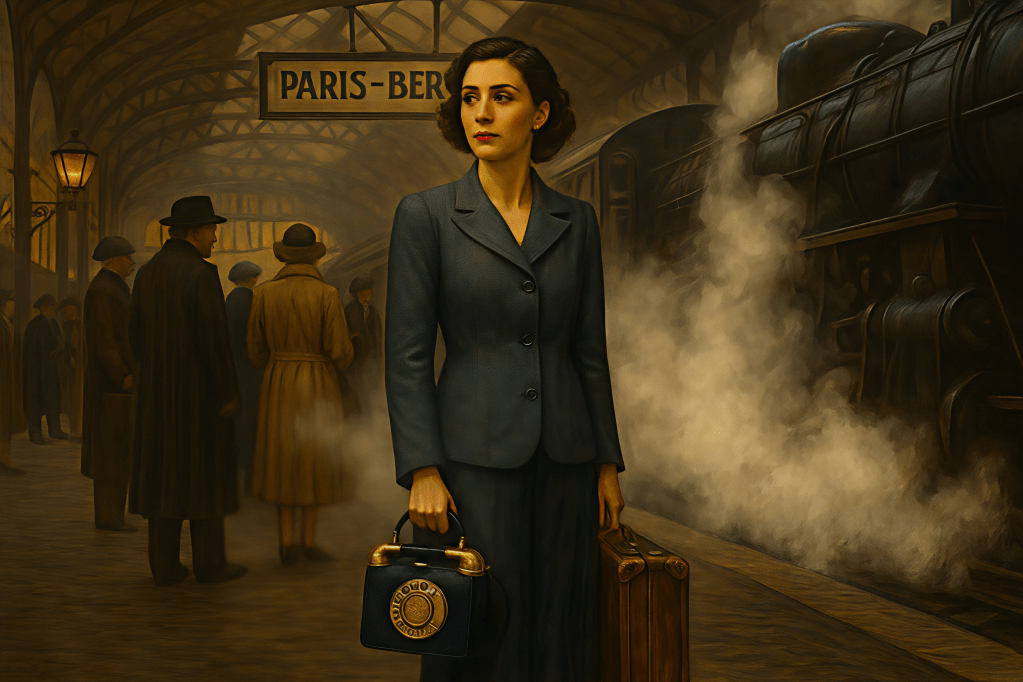
She left for Berlin on June 12th, carrying a single suitcase and a letter of introduction from Schiaparelli that was both genuine and utterly false. I walked her to the Gare de l’Est, playing the role of concerned business associate, making sure she was seen, that our connection was public and explicable.
At the platform, she turned to me. “Two weeks. If you don’t hear from me by June 26th, assume the worst.”
“How will you contact me?”
“I’ll find a way. Watch the fashion magazines. Watch for—” She paused, thinking. “—for anything that seems deliberate. A model wearing the wrong scarf. A photograph staged oddly. I’ll find a way to signal.”
“Colette—”
“Don’t.” She touched my arm briefly. “Don’t make this harder than it is. I’m doing this because it matters. Because we need to know what’s coming. Because—” She stopped, looked away. “Because I’m tired of being beautiful and useless. I want to be beautiful and dangerous.”
“You already are.”
She smiled faintly. “Then I want to be more dangerous.”
The train whistle blew. She picked up her suitcase, turned towards the platform, then paused.
“Miles? If I don’t come back—tell Marcel he was right. Tell him I was foolish and reckless and everything he said I was.” She looked back at me. “But tell him I’d do it again.”
Then she was gone, swallowed by the crowd and the steam and the great machine of Europe grinding towards war.
The city felt different after she left. Emptier, somehow, as if her absence had removed something essential. We met on the balcony twice a week, but the conversations were muted, distracted. We were all waiting for news that might never come.
Marcel threw himself into work, stitching codes into jacket linings with almost manic precision. Lucien painted furiously, domestic scenes that grew darker, more abstracted, the hidden messages more urgent. Élise developed new formulas—compounds that could burn slowly, invisibly, eating through paper over days rather than hours.
And I travelled. To London, to report what little we knew. To Lyon, to establish new contacts. To Brussels, where the streets were full of refugees who could read the future better than any diplomat.
It was in Brussels, in a café near the Grand Place, that I met Antoine.
He was perhaps seventeen or eighteen, thin and wiry, with dark hair that needed cutting and the restless energy of someone who hasn’t learnt to sit still. He worked as a bicycle courier, delivering packages and messages across the city for anyone who would pay. I noticed him because he was watching me—not obviously, but with the focused attention of someone gathering information.
When he approached my table, he didn’t ask permission to sit.
“You’re English,” he said in accented but serviceable English.
“Yes.”
“You buy things. Fashion. Perfume.”
“Sometimes.”
“You travel a lot. Paris, London, here.”
I set down my coffee carefully. “Is there a reason you’re telling me things I already know?”
“Because I think you’re more than a buyer.” He leant forward. “I think you carry things that aren’t on manifests. I think you talk to people who don’t want to be seen talking. I think—” He paused. “—I think you’re preparing for something.”
“That’s a dangerous thing to think.”
“Everything is dangerous now, monsieur. The question is which dangers are worth taking.” He looked away briefly, then back. “I’m from Le Chambon-sur-Lignon. Small village in the Cévennes. Protestant place—we’ve been sheltering refugees since the 1600s. My parents taught me to help people when they need it. That’s what we do. What God calls us to do.”
I studied him: too young to have much past, old enough to have seen things that aged him. “Why are you telling me this?”
“Because I want to help. Because I’m fast and invisible and everyone trusts couriers. Because—” He stopped, looked away. “Because I’m French, and France is about to be invaded. And I want to do something that matters before that happens.”
“What makes you think I can offer you that?”
“You’re sitting in a café in Brussels reading fashion magazines whilst everyone else is reading newspapers about the war. Either you’re insane or you’re hiding in plain sight.” He met my eyes. “I think you’re hiding.”
“And if I am?”
“Then you need someone who can move fast. Who knows the backstreets. Who can cross borders without papers because he’s done it a hundred times carrying packages that lazy customs officials don’t want to spend time examining too closely.” He paused. “I can be useful, monsieur. If you let me.”
I thought about Colette in Berlin, alone and unreachable. I thought about the cell in Paris, undermanned and overextended. I thought about Pemberton’s careful instructions to build networks, establish contacts, prepare for contingencies.
“What’s your name?”
“Antoine Moreau.”
I felt something cold in my chest. “Moreau? Any relation to Lucien Moreau? The painter?”
His face closed. “He’s my uncle. I haven’t seen him in three years. We—” He stopped. “We disagreed about things. But I know his work. I know what he’s doing.”
“And what is he doing?”
“Hiding messages in paintings. Selling resistance disguised as art.” He leant back. “I told you. I notice things. I watch. And I want to help.”
I brought Antoine to Paris two weeks later, after checking his story with contacts in Brussels and confirming that he was exactly what he appeared to be: a courier with quick hands and few scruples about what he carried.
Lucien’s reaction was not what I expected.
“Non.” He said it flatly, standing on the balcony with his arms crossed. “Absolutely not.”
“He’s your nephew,” I said.
“Which is exactly why he can’t be involved. If I’m caught, if this all falls apart, I don’t want him dragged down with me.”
“He’s already involved. He figured out what you’re doing. He wants to help.”
“He’s nineteen years old. He’s a child.”
“I’m not a child,” Antoine said from the doorway. Neither of us had heard him come up the stairs. He stepped onto the balcony, looked at his uncle. “I stopped being a child when Papa died in ‘37. When Maman sent me to work in Brussels because there was no money. When I learnt to cross borders with packages that would get me shot if I was caught.” He paused. “You don’t get to decide what risks I take, Uncle. Not anymore.”
They stared at each other, separated by three years and a gulf of things unsaid.
“You’re too much like me,” Lucien said finally. “That’s the problem. You think you’re invincible.”
“No. I think I’m useful. There’s a difference.”
Marcel had been watching quietly. Now he spoke. “Can you ride from Paris to Brussels in one day?”
“Depends. Train to Lille, then cycle? Ten to twelve hours. All bicycle if I need to avoid stations? Eighteen to twenty, maybe less if I push hard and get lucky. ”
“Can you memorize messages? Twenty, thirty lines of text?”
“Yes.”
“Can you lie to border guards without hesitating?”
“Yes, I think so.”
Marcel looked at me, then at Lucien. “We need him. Colette is in Berlin. We’re down a courier. And if war comes—when war comes—we’ll need someone who can move fast without papers.”
“He’s my nephew,” Lucien said again, but his voice had lost its certainty.
“Which means you taught him to pay attention,” Antoine said quietly. “You taught me to look at things carefully. To see what others miss. You taught me that, Uncle. Now let me use it.”
Antoine proved himself three days later.
We’d sent him to Lyon with a message for a contact there—a fabric merchant who reported on German business movements through Alsace. Simple enough. Antoine was supposed to deliver the message, wait for a reply, return to Paris.
He came back early, arriving at the Montalembert just after dawn, out of breath and bleeding from a cut above his eye.
“We have a problem,” he said, standing in my room whilst I made coffee and Élise cleaned his wound. “Your contact in Lyon. Monsieur Beaumont.”
“What about him?”
“He’s talking to Germans. I saw him at a restaurant, having dinner with two men in civilian clothes. German accents. They were discussing fabric contracts, but—” He winced as Élise applied iodine. “—but they were also discussing you. By name. They know you’re buying more than fabric.”
“Did they see you?”
“No. I was delivering to the restaurant. Just another courier. Invisible.” He paused. “But Monsieur Penbury, Beaumont gave them your hotel in Paris. They know where you’re staying.”
I felt the room tilt slightly. “When was this?”
“Yesterday afternoon. I left immediately, rode through the night.”
“Sixteen hours,” Marcel said softly. He’d arrived moments earlier, summoned by a note from Élise. “You rode sixteen hours to warn us.”
“Yes.”
Marcel looked at Lucien. “He’s useful.”
“He’s reckless,” Lucien replied, but there was something else in his voice now. Pride, perhaps. Or fear.
“We need to move you,” Élise said to me. “If they know the Montalembert—”
“No.” I was thinking quickly, calculating. “If I move suddenly, that confirms their suspicions. But if I stay, if I continue business as usual—”
“They’ll watch you,” Marcel finished.
“Let them watch. Let them see exactly what I claim to be: a buyer of French luxury goods. Nothing more.” I paused. “But we can’t meet here anymore. Not on the balcony. It’s too visible.”
“Where, then?”
“Lucien’s studio,” Antoine suggested. “Montmartre. Five stories up, back entrance through the bakery. No one notices artists coming and going.”
We looked at him: nineteen years old, bleeding and exhausted, and already thinking tactically.
“Welcome to the group,” Marcel said quietly.
We moved operations to Lucien’s studio the next week. It was smaller than the balcony, more cramped, but harder to watch and easier to explain. Artists and their friends. Models posing. The usual bohemian chaos of Montmartre.
The balcony at the Montalembert I kept for show—for meetings with legitimate clients, for the visible life that justified my presence in Paris. I still stood there in the evenings, watching Notre-Dame, smoking, playing the role of contemplative English businessman. And I knew, sometimes, that I was being watched.
Let them watch, I thought. Let them see nothing but what I wanted them to see.
But in Montmartre, above a bakery that smelt of bread and yeast, we planned for war.
June 26th came and went. No word from Colette.
June 27th. Nothing.
June 28th. Still nothing.
On June 29th, a package arrived at the Montalembert. Inside was a fashion magazine—Eleganz, a German publication I’d never seen before. No note. No return address. Just the magazine, wrapped in plain paper.
I took it to Lucien’s studio, where the others were waiting.
“It’s from her,” I said, though I didn’t know how I knew.
We went through it page by page. Fashion photographs, advertisements, articles about summer collections. Nothing obvious. Nothing that screamed message.
Then Lucien, leaning over my shoulder, said: “There. Page forty-three.”
It was a photograph from a fashion show in Berlin. Models on a runway, wearing evening gowns. And in the background, barely visible, a woman watching from the audience.
Colette.
She wore a dark suit. Her hair was different, shorter. But it was unmistakably her. And around her neck, visible if you knew to look, was a scarf we recognised—one of Marcel’s pieces, with a specific pattern we’d used for coded messages.
The pattern said: Safe. Working. Three months.
“Three months,” Élise said softly. “She’s asking for three months.”
“Or warning us we have three months,” Lucien added.
“Before what?”
No one answered. We didn’t need to. We all knew what was coming.
War. Occupation. The end of everything we’d built.
Three months.
July passed in a fever dream of preparation. We established backup meeting points. Developed new codes. Moved supplies to safe houses. Antoine proved invaluable—fast, clever, invisible in the way only the young can be invisible.
Marcel created a new identity for himself, papers that would let him claim Swiss citizenship if needed. Élise moved her most sensitive formulas to three different locations, burying them in the kinds of places no one would think to search. Lucien painted less, watched more, his eyes darkening with the knowledge of what was coming.
And I travelled. To London, to Brussels, to Lyon—where I confronted Beaumont in his shop and discovered he wasn’t a traitor, just a businessman trying to survive by keeping channels open to everyone. Not evil. Just practical in a way that would get people killed.
I told Pemberton what Colette was doing. He was silent for a long time.
“That’s extraordinarily brave,” he said finally.
“Or extraordinarily foolish.”
“In war, Penbury, those are often the same thing.” He paused. “If she’s discovered—”
“Then she’s dead. I know.”
“And the cell?”
“We’ll survive. We have to.”
“Yes,” he agreed. “You do.”
August brought heat that settled over Paris like a threat. The cafés were still full, but the conversations had changed. People spoke in lower voices. Looked over their shoulders. Made plans to leave, then postponed them, then made new plans.
And then, on August 23rd, the impossible happened: Germany and the Soviet Union signed a non-aggression pact.
We met in Lucien’s studio that night, all of us, including Bernard and Antoine, and looked at each other with the knowledge that everything had just changed.
“Poland will be invaded within days,” Bernard said. “And after Poland—”
“France,” Marcel finished.
“How long?” Élise asked.
“Months. Maybe a year if we’re lucky.”
We weren’t lucky.
On September 1st, Germany invaded Poland. On September 3rd, Britain and France declared war.
And on September 4th, a letter arrived at the Montalembert, delivered by regular post, addressed to Miles Penbury in a hand I didn’t recognise.
Inside was a single sentence in German, written in careful copperplate:
Sie hat recht. Der Krieg kommt früher als gedacht. Bereiten Sie sich vor. —K.H.
My German was serviceable. I translated it aloud for the others:
“She was right. War comes sooner than expected. Prepare yourselves. —K.H.”
“Hartmann,” Marcel said.
“Yes.”
“Colette told him about us.”
“Or he figured it out and she confirmed it. Either way—” I looked at the letter. “—he’s warning us.”
“Or setting us up,” Lucien said.
“Maybe. But I don’t think so.”
“Why not?”
I thought about the man in the café, the one who’d bought paintings because they were beautiful and dangerous. The one who’d chosen not to report what he’d seen because he wanted to believe resistance was possible.
“Because he’s still the same problem he always was,” I said. “A man who loves beauty but serves ugliness. And right now, we’re the beauty he’s trying to protect.”
“Then we’re in even more danger than we thought,” Antoine said quietly. “Because men like that always have to choose eventually. And when they do—”
He didn’t finish. He didn’t need to.
We all knew that when Hartmann finally chose, it would cost someone everything.
The last message from Colette came in mid-September, hidden in another fashion magazine. This time, the photograph showed a model on a Berlin street, wearing a coat we recognised and carrying a handbag positioned at a specific angle.
The message was brief: Leaving. Return October. Trust Hartmann.
Two weeks later, on September 29th, she walked into Lucien’s studio as if she’d only been gone for an afternoon.
She was thinner. Her eyes were harder. She moved differently, with a wariness that suggested she’d learnt to expect violence from any direction.
But she was alive.
We gave her wine and bread and let her sit in silence for ten minutes before asking anything.
Finally, Marcel spoke. “What did you learn?”
Colette looked at each of us in turn. Then she said, very quietly:
“They’re coming. Not this year, probably not this winter. But spring. May, maybe June. They’ll come through Belgium and around the Maginot Line. They’ll take Paris in weeks, maybe days.” She paused. “And they’re planning for it. For the occupation. For how to control the city. For which businesses to seize and which to protect. For who will collaborate and who will resist.”
“How do you know this?”
“Because I slept with Richter’s assistant. And I read his files whilst he was sleeping.” She said it flatly, without emotion. “I learnt what they’re planning for Paris. For the fashion houses. For the art world. For all of it.”
She pulled papers from her coat—carbon copies, notes, sketches. Lists of names. Buildings. Businesses.
“Parfums Garnier is on here,” she said, handing one to Élise. “Marked for ‘protection and monitoring.’ They want Bernard to keep working. They want French perfume to continue. But they’ll watch every bottle, every formula.”
She handed another sheet to Lucien. “Galerie Rousseau. Listed for ‘cultural preservation.’ Which means they’ll control what art is shown and who buys it.”
Another to Marcel. “Fashion houses. All the major ones. They’re planning to keep them open, keep them functioning. They want Paris to look normal. They want French fashion to legitimize German rule.”
“And us?” I asked.
She looked at me. “You’re not on any list. Which either means they don’t know about you, or—” She paused. “—or they’re waiting to see what you do.”
“Hartmann?”
“Is in the Wehrmacht now. Captain—they fast-tracked him because of his doctorate. He’ll be posted to Paris when they take it. Cultural Affairs office. He’ll be responsible for protecting art, architecture, monuments.” She paused. “And he told me to tell you: he remembers the paintings. He remembers what you said about choosing beauty. And he’ll try.”
“That’s not a promise,” Marcel said.
“No,” Colette agreed. “But it’s the best we’re going to get.”
We worked through the night, planning. Creating contingencies. Identifying what could be saved and what would have to be sacrificed. Learning to think like people who might not survive but whose work needed to.
As dawn approached, I found myself alone on the studio’s small balcony—not the ample one at the Montalembert, but a narrow ledge barely wide enough for one person. Paris spread below, the rooftops grey in the early light, Notre-Dame distant but visible.
Marcel joined me, lighting a cigarette against the chill.
“She’s still there,” he said quietly. “Still in Berlin. Still in danger.”
“Yes.”
“The intelligence she’s sent—it’s extraordinary. Detailed. Precise.” He paused. “It’s also a death sentence if they discover what she’s doing.”
I thought about Colette in Berlin, alone, gathering intelligence that could get her killed. About the note she’d included: I’m staying as long as I can.
“How long do you think she can maintain it?” Marcel asked.
“Her note said three months. But based on these documents—” I gestured back toward the studio where the others were still studying Colette’s intelligence. “—based on what she’s describing, I’d say six months. Maybe eight. And then everything changes.”
“And if she’s still there when the invasion comes?”
I had no answer for that. None of us did.
Behind us, through the studio window, I could see the others: Élise organizing the documents by category, Lucien sketching maps based on Colette’s notes, Antoine sleeping in a chair, exhausted from another sixteen-hour ride.
A tailor, a chemist, a painter, a courier, a model still in Berlin, and an importer who had all decided that beauty was worth fighting for.
It wasn’t much of an army.
But it was ours.
“She’ll come back,” I said, though I didn’t know if I believed it. “When she can. When it’s safe.”
“And if it’s never safe?”
We stood there as the city woke, two men on a narrow balcony, watching Paris prepare itself for an invasion that would come whether it was ready or not.
And in Berlin, Colette Marchand continued her work, gathering intelligence, playing her dangerous game, staying as long as she could.
We wouldn’t see her again until Paris fell.
By June of 1940, Paris would fall, and we would learn what it cost to resist from the inside of our own prison.
But that morning, in late September 1939, we still had time. Not much. But enough.
Enough to prepare.
Enough to hope.
Enough to believe that when the Germans came, we would be ready.
We weren’t ready. No one ever is.
But we were waiting.
And that would have to be enough.
 Lamp & Ledger