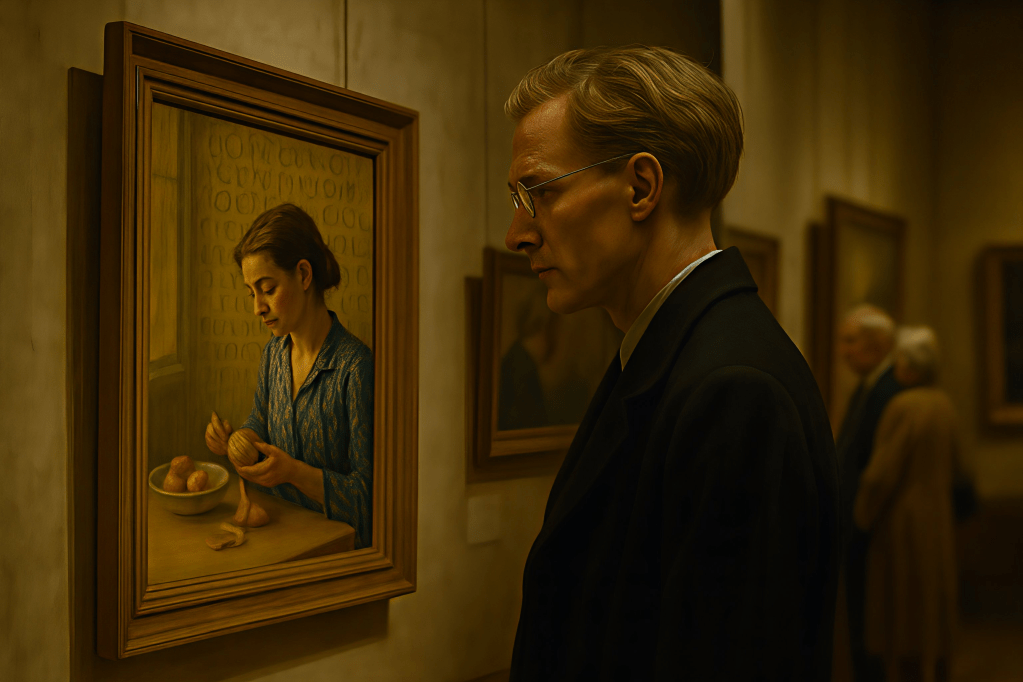
The Hartmann Problem
Episode 2: The Hartmann Problem
Paris, January—March 1939
…as remembered in London, October 1946
Winter settled over Paris like a held breath. By January, the city had learnt to live with the possibility of war the way one lives with a chronic illness—acknowledged but not discussed, always present but carefully ignored. The cafés remained full. The fashion houses prepared their spring collections. Notre-Dame stood against grey skies, and from my balcony at the Montalembert, I could watch the city pretend that nothing was going to change.
But everything was changing, slowly, in ways that only became visible later.
The cell had found its rhythm. We met twice a week on my balcony, usually after dark, ostensibly to discuss art and fashion and the commerce that justified my presence in Paris. Marcel brought fabric samples with messages stitched into selvages where the threads changed colour. Colette practiced the gestural codes she would use on runways—three fingers on a scarf meant urgent, a turned wrist meant wait, a specific tilt of the head meant compromised. Lucien painted domestic scenes where the wallpaper patterns formed letters if you knew the key. Élise developed invisible inks that revealed themselves under heat or specific chemical treatments.
And I carried it all back to London once a month: intelligence about German business investments in France, about which French industrialists were preparing to collaborate, about military movements observed by people who sold them fabric or perfume or art.
We were useful. Small, but useful. Pemberton’s careful letters acknowledged this with the bureaucratic praise of men who cannot afford to be effusive.
But by February, I had begun to notice something troubling: we were being watched.
Not by the French police, though they were certainly paying attention to foreigners—like me. Not by obvious agents or suspicious men in cafés. The watching was subtler than that—a sense of pattern, of repetition, of someone interested in the same things we were interested in.
It started at the Galerie Rousseau.
I had gone on a Thursday afternoon to view an exhibition of recent work by younger painters—Lucien amongst them, though his name on the program was listed simply as “L. Moreau” to avoid too much attention. The gallery was nearly empty: Madame Rousseau at her desk, an elderly couple examining a Braque, and a young man in a dark coat standing in front of one of Lucien’s paintings.
He stood there for twenty minutes. Not moving, barely blinking, studying the canvas with the intensity of someone reading text rather than viewing art.
The painting was called Interior with Apples—a woman at a kitchen table, peeling fruit, afternoon light coming through a window. Beautiful in its ordinariness. And, if you knew how to look, the wallpaper behind her, a coded cipher—coordinates, perhaps, or names hidden in motif.
The young man took notes in a small leather journal. Then he moved to the next Moreau painting and did the same thing.
I approached casually, hands in pockets. “Interesting work,” I said in French.
He glanced at me—fair hair, wire-rimmed glasses, the thin face of someone who reads more than he sleeps. Mid-thirties, perhaps. German accent when he replied. “Very interesting. You know his work?”
“A little. I’m in the import business. Art, fashion, that sort of thing.”
“Ah.” He closed his journal. “Then you understand quality.”
“I understand what sells.”
“Not always the same thing.” He smiled slightly, turned back to the painting. “But this—this is both. Beautiful and useful.”
Something cold moved through me. “Useful?”
“Structurally. The composition. The way he uses pattern to create depth.” He gestured at the wallpaper. “See how it repeats? But not randomly. There’s an order to it. Almost mathematical.”
“I hadn’t noticed.”
“Most people don’t.” He extended his hand. “Klaus Hartmann. I’m a student at the Sorbonne. Art history.”
“Miles Penbury.”
His grip was firm, brief. “English?”
“Yes.”
“You’re far from home.”
“So are you.”
He laughed, surprising both of us. “True. But Paris is—” He paused, searching for words. “—where one comes to understand what art means. What beauty can do.”
“And what can it do?”
“Change how we see the world. Make the invisible visible.” He looked at me directly. “Make us pay attention to things we might otherwise miss.”
We talked for perhaps fifteen minutes—about Cézanne’s influence on Cubism, about whether abstraction was liberation or retreat, about the difference between German and French approaches to modernity. He was intelligent, articulate, and genuinely passionate about art in a way that made me almost forget he was German.
Almost.
When he left, I realized he must be the buyer Madame Rousseau had written about. The student who’d purchased Interior with Apples but hadn’t collected it yet. The one who wanted to study it further.
I stayed behind, pretending to examine other works.
“How long has he been coming here?” I asked Madame Rousseau quietly.
“Since 1935. Three, four times a year. Always buys something. Always French modernists.” She adjusted her glasses. “Why?”
“Just curious.”
“Monsieur Penbury.” Her voice was very soft. “If there’s something I should know about that painting—”
“There isn’t,” I lied. “It’s just a painting.”
I told them that night, on the balcony, whilst frost formed on the railing and Notre-Dame was a dark shape against darker sky.
Lucien went pale. “The German student who bought it—you saw him?”
“Yes. At the gallery. Studying it. He hasn’t collected it yet.”
“My God,” Lucien said. “If he decodes it—”
“He may have already,” Marcel said quietly. “That’s why he’s still studying it.”
“We have to assume he knows,” Colette said, lighting a cigarette with hands that weren’t quite steady. “We have to assume he’s Abwehr or SD—German intelligence, one branch or another.”
“He’s a student,” I interrupted. “At the Sorbonne. I checked with the university registrar this afternoon. Klaus Hartmann, enrolled since 1935, doctoral candidate in art history. Thesis on Cézanne’s influence on French Cubism. No political affiliations listed. No connections to German intelligence that I can find.”
“That you can find,” Marcel repeated. “Which means nothing.”
“It means he’s either very good at hiding, or he’s exactly what he appears to be.”
“No one is exactly what they appear to be,” Élise said quietly. “Not anymore.”
She was right, of course. We were proof of that.
“What was the message?” I asked Lucien. “In the painting he bought.”
Lucien closed his eyes, remembering. “It said: ‘Three shipments stopped at Strasbourg. Check manifests.’ It was intelligence about German materials moving through Alsace. Six weeks old. Probably useless now.”
“But enough to prove what you’re doing.”
“Yes.”
We sat in silence, watching our breath cloud in the cold air.
“We have three options,” Marcel said finally. “We stop. We run. Or we find out what Hartmann knows and what he plans to do with it.”
“How do we do that?” Colette asked.
They all looked at me.
I found him three days later at a café near the Sorbonne, reading Baudelaire and drinking coffee that smelt better than anything else in Paris that winter.
“Monsieur Hartmann.”
He looked up, not surprised. “Monsieur Penbury. Would you like—”
I sat before he could finish. “I want to talk about the painting you purchased.”
“Interior with Apples? I haven’t collected it yet. Still studying it before I have it shipped to Munich.”
“That’s what I’m afraid of.”
“Why would you be afraid of a painting?”
“Because,” I said carefully, “I think you noticed something that most people miss.”
He set down his book, removed his glasses, cleaned them with meticulous care. When he put them back on, his eyes behind them were very clear, very direct.
“The wallpaper,” he said quietly.
“Yes.”
“It forms letters. A message. I worked it out on the train after my first visit. It took me three hours, but I found the key.”
My heart was pounding, but I kept my voice level. “And what did you do with that information?”
“I came back to the gallery. To study it more carefully. To see if I was right.” He paused. “It’s very beautiful.”
“That’s all?”
“What else would I do?”
“Report it. Tell your embassy. Tell—” I stopped. “Why didn’t you?”
He was quiet for a long time, watching steam rise from his coffee. “Do you know why I came to Paris, Monsieur Penbury?”
“To study art.”
“To escape.” He said it simply, without drama. “To escape Germany. To escape what Germany is becoming. I grew up in Munich, in a Lutheran family, very traditional. Reformation heritage, all of that. But I watched the German Christians accept the Aryan Paragraph in ’33, watched them turn Luther into Reich theology. When I was twenty-two, I had a choice: stay and watch it happen, or leave whilst leaving was still possible. So I came to Paris.”
“To study art.”
“To escape. And yes, to study. To learn that beauty itself can be truth. That paying attention to it matters.” He paused. “But eventually, the law catches everyone. Wehrmacht conscription. All German men of military age. So I’ll return, serve as required, and hope they assign me to something that lets me preserve rather than destroy.”
“You’ll wear a uniform you don’t believe in.”
“Yes. That’s the cost of being German now. You serve, whether you agree or not. The question is whether you can keep your soul whilst doing it.”
“And you’re not going to report it.”
“No.”
“Why not?”
“Because I want to believe that resistance is possible. That there are still people who care enough to hide messages in wallpaper. That Paris hasn’t given up.” He leant forward. “Are you one of those people, Monsieur Penbury?”
It was the moment where everything could break. Where I could lie and possibly be believed, or tell the truth and possibly be destroyed.
I chose something in between.
“I know people who are,” I said.
“Good.” He sat back, picked up his coffee. “Then I’ll keep buying paintings. And I’ll keep not noticing what’s hidden in them. And maybe, when the war comes—and it will come, we both know that—I’ll remember that there were people in Paris who believed that beauty could mean something more than decoration.”
“You’re going back to Germany.”
“Next month. My studies are nearly finished. And there’s—” He stopped. “There’s military service. I’m being called up. I’ll be an officer. Cultural affairs, probably, because of my background. But still. An officer.”
“In the army that will invade France.”
“Yes.” His voice was very quiet. “That’s the cost of my choices. I can’t escape that.”
“You could stay here.”
“And be what? A refugee? A traitor? I can’t betray my country, Monsieur Penbury. But I can remember what I loved about Paris.”
We met twice more before he left Paris—once at the Galerie Rousseau, where he bought another Moreau painting, and once on a cold March evening at the café near the Panthéon where he said goodbye to a city he might see again only as a conqueror.
“If the war comes,” he said, “and if I’m posted to Paris—”
“Will you protect it?”
“I’ll try to protect what I can. Art. Architecture. The things that make Paris Paris.” He paused. “And if I encounter people like your friends—people who hide messages in paintings—I’ll remember this conversation.”
“That’s not a promise.”
“No. It’s not. I can’t promise anything. I’m going to wear a uniform that represents things I don’t believe in. I’m going to follow orders I don’t agree with. I’m going to be part of an occupation that will destroy everything I loved about being here.” He looked at me. “But I’ll try to be the man who bought paintings because they were beautiful. Even when they were dangerous.”
“The Hartmann Problem,” I said.
“What?”
“That’s what we’ll call it. The problem of men who love beauty but serve ugliness.”
He smiled sadly. “Yes. That’s me. A problem with no solution.”
“Maybe the solution is just to keep choosing beauty. Every time you can.”
“Maybe.” He stood, gathered his coat. “Goodbye, Monsieur Penbury. I hope we don’t meet again. But if we do, I hope you’ll remember that I could have reported that painting and didn’t.”
“I’ll remember.”
And then he was gone, walking away through streets that would soon be German streets, a man caught between two identities and loyal to neither.
I told them everything that night—Hartmann’s confession, his promise that wasn’t a promise, his return to Germany and probable return to Paris in uniform.
“It’s a trap,” Marcel said immediately. “He’s gaining your trust so that when he comes back—”
“Then why wait?” I interrupted. “Why not arrest us now? Why buy paintings and have conversations and leave evidence that he knew and did nothing?”
“Maybe he wants bigger fish. Maybe he’s building a case.”
“For four months? While studying Cézanne?” I shook my head. “No. I think he’s exactly what he says he is: a man who loves Paris and hates what his country is becoming.”
“That doesn’t make him safe,” Colette said.
“No. But it makes him possible.”
Lucien had been quiet, staring at his hands. “He has two of my paintings now. Two coded messages. If he decodes them both—”
“Then he knows we’re watching German materials movements through Alsace and that we have contacts in the fashion industry who report on German business investments.” I paused. “Old information. Useful but not devastating.”
“Yet,” Élise added.
“Yet,” I agreed.
We stood on the balcony, watching Notre-Dame fade into darkness, and considered what we had created: a network that was known to at least one German who would soon be an officer. A vulnerability that could destroy us or, possibly, protect us.
“We change nothing,” Marcel said finally. “We assume he’s hostile. We plan for him to be posted to Paris when the invasion comes. We prepare to either use him or avoid him.”
“Or kill him,” Lucien said quietly.
No one disagreed.
Hartmann left Paris in late March, just as the trees along the Seine began to bud and the city started to believe, briefly, that maybe war wouldn’t come after all.
I saw him once more, by accident, at the train station. He was buying a ticket to Munich, carrying a single suitcase and a portfolio that probably held books and notes and perhaps, tucked carefully inside, two paintings by an artist who hid messages in wallpaper.
Our eyes met across the station. He nodded once, a gesture so small it might have been imagination.
I nodded back.
And then he was gone, and I was alone in a train station that smelt of coal smoke and goodbye, wondering if I had just made an alliance that would save us or a mistake that would kill us all.
That night, I stood on my balcony and looked at Notre-Dame—solid, eternal, indifferent to the small dramas of people who thought they could resist what was coming.
Élise joined me, bringing coffee that was nearly real and cigarettes that weren’t.
“Do you think he’ll keep his word?” she asked.
“I don’t know. I don’t know if he even knows.”
“Then why did you trust him?”
I thought about that for a long time. “Because he bought a painting that could have destroyed him. Because he studied it for three hours instead of three minutes. Because he wanted to believe that resistance was possible.” I paused. “Because I needed to believe that not all Germans are monsters.”
“That’s a dangerous thing to need.”
“Everything we do is dangerous.”
“Yes.” She smoked in silence, watching the city. “But some dangers feel different. This one feels—” She searched for the word. “—personal.”
“It is personal. That’s what makes it dangerous. And that’s what makes it possible.”
We stood there until the cold drove us inside, two people on a balcony in a city that was running out of time, hoping that beauty and art and the memory of someone who loved Paris might be enough to matter when the war finally came.
It would have to be enough.
We had nothing else.
Two weeks after Hartmann left Paris, Colette came to my balcony alone.
It was late afternoon, the kind of pale spring light that makes everything look temporary. She didn’t wait for me to offer her a chair or cigarette. She simply stood at the railing, looking towards Notre-Dame, and said:
“I’ve been approached.”
The air between us changed. “By whom?”
“A businessman. German. He said his name was Richter. He was at the Schiaparelli show last week, sitting in the front row. Afterward, he waited by the changing rooms.” She lit her own cigarette, her hands steady. “He said he represented German interests. Fashion interests. He said that when—not if, when—Germany establishes closer relations with France, there would be opportunities for models who understood how to appeal to German sensibilities.”
“What did you say?”
“I said I’d think about it.” She turned to look at me. “He gave me a card. An address in Berlin. He said I should visit. That I’d be well compensated for my time. That beautiful French women would be very valuable in the new Europe.”
I felt something cold settle in my chest. “He’s recruiting you.”
“Yes.”
“For what? Intelligence? Propaganda?”
“I don’t know. Maybe both. Maybe he just wants a pretty French face to legitimize German fashion houses. Or maybe—” She paused. “—maybe someone told him I’m worth recruiting. Someone who thinks I might be useful for more than just modeling.”
We both understood what she meant. Someone who knew, or suspected, what we were doing.
“Hartmann,” I said quietly.
“Maybe. Or maybe Richter is just what he appears to be: a businessman preparing for occupation.” She dropped her cigarette, ground it under her heel. “But Miles, if they’re recruiting me now—in March, before anything has even started—then they’re planning something bigger than we thought. And they’re planning for us specifically. For the fashion industry. For the luxury trades.”
“For the things we use to hide our work.”
“Yes.”
Below us, Paris moved through its evening routines, oblivious. From somewhere came the sound of accordion music, and laughter, and the rattle of a passing cart.
“What do you want to do?” I asked.
She looked at me with those sharp, dark eyes. “I want to say yes.”
“Colette—”
“If they’re recruiting me, it means they see me as valuable. It means I could get close to them. Learn their plans. Maybe even—” She stopped. “We’ve been playing defence, Miles. Watching and reporting. But if I say yes to Richter, we could play offense. We could see what’s coming before it arrives.”
“Or you could disappear into Germany and never come back.”
“That’s possible.” She said it calmly, as if discussing the weather. “But if I don’t go, we’ll spend the next year wondering what we missed. What we could have prevented.”
I thought about Hartmann, about the choice he’d made to notice our work and do nothing. About the problem of people caught between two identities.
“You’d be alone,” I said. “In Berlin. No backup. No way to get messages out safely.”
“I know.”
“Marcel will say no.”
“Marcel doesn’t decide.” Her voice was quiet but absolute. “None of you decide. This is my risk to take.”
We stood there as the light faded, two people on a balcony, looking at a city that was running out of time.
“The card,” I said finally. “Let me see it.”
She handed it to me: heavy stock, expensive. An address in Berlin. A telephone number. And a name printed in elegant script:
Dieter Richter Handelskammer für Deutsche Modeinteressen Berlin
Chamber of Commerce for German Fashion Interests.
I turned it over. On the back, written in pencil in a hand I didn’t recognise:
We should discuss Lucien Moreau’s work. I think you understand its value.
My blood went cold.
“He knows,” I said.
“Yes.” Colette took the card back, studied it. “The question is: does he want to use what we’re doing, or stop it?”
“Or both.”
“Or both.”
She tucked the card into her coat pocket, straightened her scarf with that particular grace that made every gesture look deliberate, coded.
“I’m going to say yes,” she said. “Not now. Not immediately. I’ll make him wait. Make him think I’m considering. But eventually, I’ll go to Berlin.” She looked at me. “And when I do, you need to be ready to either extract me or forget I existed.”
“Colette—”
“Promise me, Miles. If this goes wrong, you cut me loose. You protect the others. You keep working.”
I wanted to argue. To tell her it was too dangerous, too uncertain, too much like something that would destroy her.
But I looked at her face—twenty-five years old and already harder than most people ever become—and I knew she had already decided.
“I promise,” I said.
She nodded once, then turned towards the door. At the threshold, she paused.
“Tell Marcel I’ll be at the next meeting. Tell him we need to discuss Berlin.” She smiled faintly. “Tell him the war is starting sooner than we thought. And we’re already in it.”
Then she was gone, and I was alone on the balcony with a German business card and the knowledge that everything had just changed.
Below, Notre-Dame stood against the darkening sky, eternal and indifferent.
I wondered how much longer we had before the city fell.
I wondered if Colette would still be alive when it did.
 Lamp & Ledger