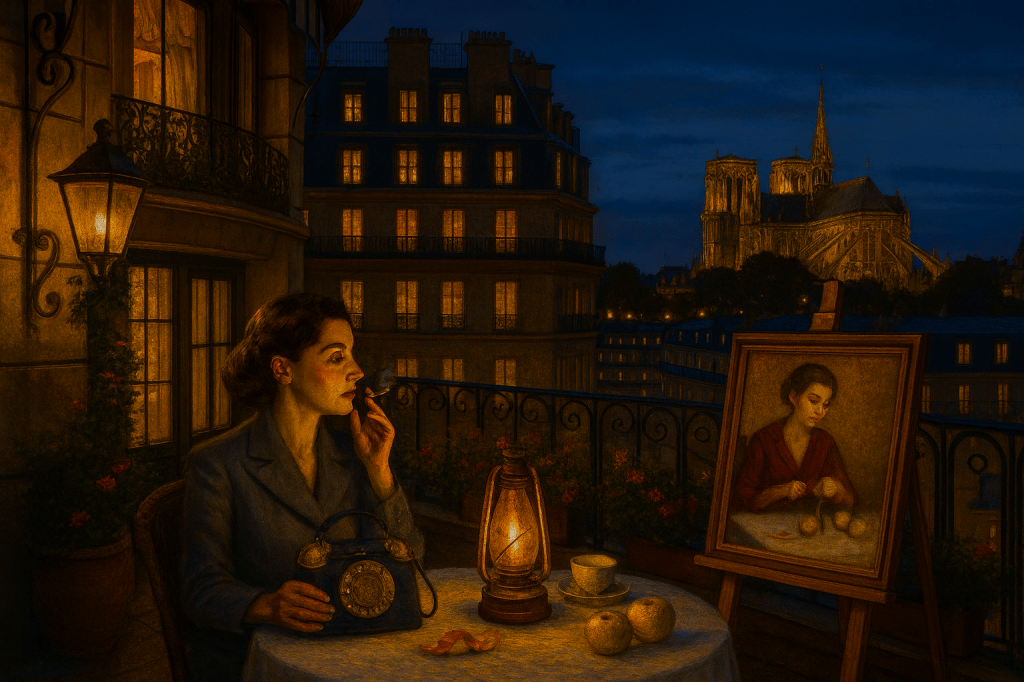
Hôtel Montalembert
Episode 1
Paris, 1938—1940
…as remembered in London, October 1946
I arrived in Paris on a Tuesday in late September, when the chestnut trees along the Seine had just begun to rust at the edges and the light fell through the city in that particular amber slant that makes everything—even war, even memory—beautiful. It was 1938. I was thirty-seven years old. I had come, as I always did, to buy things.
That, at least, was what my passport said. What my letters of introduction claimed. What the concierge at the Hôtel Montalembert believed when I tipped him generously for the third-floor room with the ample balcony that overlooked Rue du Bac. From that balcony, if one stood at the right angle, Notre-Dame rose above the rooftops like a promise the city had made to itself centuries ago. I requested that room specifically. The view, I told the concierge, inspired me.
This was true, though not in the way he imagined.
Miles Penbury, importer of French luxury goods: silk scarves, evening gowns, bottles of perfume stoppered with glass shaped like doves. I had built a decent business ferrying beauty across the Channel for English women who wanted to smell like Paris and look like Schiaparelli. It was respectable work. Profitable, even.
It was also, by the autumn of 1938, a lie.
Not entirely, of course. The best covers never are. I still bought perfume. I still attended fashion shows, took meetings with ateliers, signed contracts for shipments of Chantilly lace. But now I also reported to a man named Pemberton who worked out of an unmarked office near Westminster and who had, with great delicacy and no small amount of brandy, explained to me that His Majesty’s government had a rather urgent need for men who could move freely through Paris, who knew the luxury trade, who might be trusted to keep their eyes open and their mouths shut.
“You’re not a soldier, Penbury,” he’d said, lighting his pipe. “And we’re not asking you to be one. Just… watch. Listen. There are people in Paris who matter. People who talk. You’d be surprised what gets said over a fitting for a gown or a contract for rose oil.”
I was not particularly surprised. I had spent fifteen years listening to people who thought commerce made them invisible.
So I came to Paris that September with two sets of instructions: one from Pemberton, written in a hand so careful it might have been calligraphy, and one from Madame Richaud of the Parfumerie Fontaine, who wanted eight cases of Nuit de Longchamp and had very specific opinions about packaging.
The former I burnt in my hotel ashtray the night I arrived, watching the ash drift over the balcony railing towards the street below.
The latter led me, eventually, to Rue de l’Espoir.
The street itself was unremarkable: a narrow passage in the 6th arrondissement that curved between Boulevard Saint-Germain and a small square with a defunct fountain and a café that served mediocre coffee. The buildings were eighteenth-century, their façades the colour of old bone, their shutters painted a faded green that might once have been fashionable. There were three shops on the ground floors: a bookseller, a tobacconist, and a tailor.
It was the tailor I needed.
I had been told—by whom, I no longer precisely remember, though it may have been Richaud or possibly the fitter at Lanvin—that if one wanted a suit made well and without fuss, one went to Marcel Duval on Rue de l’Espoir. He specialised in both men and women’s tailoring, which was unusual, but his work was discreet and impeccable. “He understands structure,” the fitter had said, which I took to mean he understood how clothes could transform a body into an idea.
I wanted a jacket. Something between English reserve and French elegance, suitable for meetings that might be in drawing rooms or, increasingly, in basement wine cellars where the air smelt of damp stone and old fear.
Marcel Duval’s shop was narrow and dim, its windows dressed with a single mannequin in a charcoal suit that looked like architecture. A bell chimed when I entered. The interior smelt of wool and steam and something else—lavender, perhaps, or rosemary. The kind of smell that makes a space feel like a secret.
He emerged from the back almost immediately: a man in his early forties, lean and compact, with dark hair graying at the temples and hands that moved with the deliberate precision of someone who has spent a lifetime measuring small distances. He wore a waistcoat without a jacket, shirt sleeves rolled to the elbows, a tape measure draped around his neck like a stole.
“Monsieur?” His voice was quiet, nearly flat.
“I’m looking for a jacket,” I said in French. “Something I can wear in London and Paris both.”
He studied me for a moment—not my face, but my shoulders, my posture, the way I stood. “English,” he said. It was not a question.
“Yes.”
“You want to look French, or you want to look English in France?”
“I want to look like myself.”
Something shifted in his expression. Not quite a smile. “That,” he said, “is more difficult.”
He gestured towards a chair and began to take measurements, his hands moving over my shoulders and chest with the impersonal intimacy of a surgeon. He asked questions about fabric weight, lapel width, button stance—technical questions delivered in a tone that suggested he already knew the answers but wanted to hear how I would phrase them.
Halfway through, he paused. “You work in fashion?”
“Importing,” I said. “Perfume, mostly. Some textiles.”
“Ah.” He made a note on a small card. “Then you know quality.”
“I know what sells.”
“Not always the same thing.” He stepped back, considering. “I can have this ready in two weeks. There’s a fitting in ten days.”
“That’s fine.”
He wrote the appointment on the card and handed it to me. His handwriting was small and very neat, almost copperplate. “Rue de l’Espoir,” he said. “Easy to remember.”
“Yes.”
“Most people think it’s ironic. A street called Hope in times like these.”
I glanced up. His face was unreadable.
“I think,” he said quietly, “it’s aspirational.”
I met Colette Marchand three days later, at a show for Schiaparelli’s autumn collection in a gilt-trimmed salon on Place Vendôme.
I had gone because Madame Richaud wanted my opinion on a handbag shaped like a telephone—an absurdity that would, she assured me, sell magnificently in London—and because Pemberton’s careful instructions had included the phrase “attend fashion events whenever possible.” I did not expect to find anything more interesting than overpriced whimsy and champagne that tasted of wire.
I was wrong.
She appeared near the end of the show, walking with the particular gliding precision of models who have learnt to make movement look effortless. She wore a black suit with a nipped waist and shoulders like the prow of a ship, and at her throat, a silk scarf printed with a pattern I couldn’t quite decipher from my seat—something geometric, vaguely Cubist, in shades of red and gold.
But it was the way she moved that caught my attention. There was a deliberateness to it, a kind of coded grammar. She paused at the end of the runway, adjusted the scarf with her left hand—three distinct movements—and turned, letting the jacket flare slightly before she walked back.
I have never been good at reading signals in cloth, but I am good at reading people. And I knew, watching her, that she was saying something.
After the show, I lingered near the champagne. She appeared beside me as if conjured, still wearing the suit, the scarf now loosened.
“You’re English,” she said. Her English was flawless, barely accented.
“Guilty.”
“You don’t look like a critic.”
“I’m not. I buy things.”
“Ah.” She accepted a glass of champagne from a passing waiter. “What did you think of the telephone bag?”
“I think it will sell very well.”
“That’s not what I asked.”
I smiled despite myself. “I think it’s ridiculous.”
“Good,” she said. “So do I. But Elsa likes jokes.” She sipped her champagne, watching me over the rim. “You’re the importer. Penbury, yes? I’ve heard about you.”
“Nothing slanderous, I hope.”
“Only that you have good taste and pay on time. In Paris, that makes you a saint.”
We talked for perhaps ten minutes—about fabrics, about London, about nothing in particular. She was twenty-five, I later learnt, though she had the self-possession of someone much older. Her beauty was the kind that photographs exaggerated and real life complicated: sharp cheekbones, dark eyes, a mouth that suggested irony even in repose.
As she turned to leave, she touched my arm lightly. “If you’re staying in Paris,” she said, “you should visit Rue de l’Espoir. There’s a tailor there. Marcel Duval. He’s very good.”
“I know,” I said. “I’ve already been.”
Her smile was brief, knowing. “Then you’ll go back.”
I returned to Marcel’s shop for my fitting on a wet October afternoon when the rain fell in sheets and the Seine looked like hammered pewter. He worked in silence, pinning and adjusting, his face a mask of concentration. The jacket fit perfectly—too perfectly, perhaps, as if he had measured not just my body but some deeper architecture of identity.
When he finished, he stepped back and regarded me with an expression I couldn’t quite read. “You have the balcony,” he said. “At the Montalembert.”
It was not a question.
“Yes.”
“The one that faces Notre-Dame.”
I felt something shift in the air between us. “How did you know?”
“Because,” he said quietly, “I was told to look for an Englishman who would request it specifically.” He paused. “There are people who would like to meet you. Tonight, if possible. At your hotel.”
“What people?”
“The kind who think a balcony with a view of the cathedral might be useful for more than admiring architecture.”
They arrived separately, just after dark, when the streets were wet and the lights of the city reflected on the cobblestones like scattered coins.
Marcel came first, carrying a parcel wrapped in brown paper that turned out to contain my finished jacket. Colette arrived ten minutes later, wearing a dark coat and a hat that shadowed her face. The man who came last was someone I hadn’t met: early thirties, dark-haired, with paint under his fingernails and the restless energy of someone who thinks in images rather than words.
“Monsieur Penbury,” Colette said, making introductions on my balcony as if we were at a dinner party. “This is Lucien Moreau. He paints.”
“Badly,” Lucien said, shaking my hand. His grip was firm, callused.
“He’s lying,” Colette said. “He paints beautifully. But usefully.”
From inside my room, Lucien retrieved a small canvas he’d brought wrapped in cloth: a domestic scene, a woman at a table peeling apples. It took me a moment to notice the pattern in the wallpaper behind her—a repeated motif that, if you knew how to look, formed letters.
“Jesus,” I said softly.
“Exactly,” Marcel said.
We stood on the balcony, the four of us, with Notre-Dame visible in the distance and the sound of the city moving below. They explained it in low voices, speaking quickly, efficiently, as if they had rehearsed.
Marcel embedded codes in seams and linings, messages that could be carried across borders in pockets and hems. Colette wore them—on scarves, in jewelry, in the way she moved on runways where German officers and Vichy bureaucrats would soon watch with hungry eyes. Lucien painted them into still lifes and landscapes that hung in galleries where people spoke too freely.
They needed someone who could move between worlds. Someone with reasons to travel, to ask questions, to buy and sell and carry things across borders without suspicion.
Someone like me.
“We’re not asking you to be brave,” Marcel said. “Only careful.”
I thought of Pemberton, of his careful handwriting and careful words. I thought of the jacket that fit too well, of the balcony I had requested without fully understanding why. I thought about whether any of this mattered—whether beauty and resistance and small acts of defiance meant anything in a world sliding towards war.
“I’m already careful,” I said.
Colette leant against the railing, looking out towards the cathedral. “Then we’ll teach you to be careless in the right ways.”
“There’s someone else,” Marcel added. “A fifth. She works with perfume. You’ll need to meet her.”
“When?”
“Soon. But first, we need to know if you’ll use this space.” He gestured at the balcony, at the open air, at the view that made my room visible and vulnerable and somehow safe all at once. “It’s exposed, but that’s useful. People expect an Englishman to take air on his balcony. To smoke. To watch the city.”
“To meet with artists and models and tailors,” Colette added, “discussing fashion and art and commerce.”
“While doing something else entirely,” Lucien finished.
I looked at them: three French citizens who had decided that clothes and paintings and beauty could be turned into weapons. Who had chosen, in their separate ways, to fight with the tools they had.
I looked at Notre-Dame, grey and eternal against the darkening sky.
“Yes,” I said. “You can use it.”
I met Élise Garnier two weeks later, in a laboratory that smelt of roses and chemicals.
The perfume house—Parfums Garnier—occupied a narrow building near the Seine, its ground floor a shop of enamel and glass, its upper floors a warren of workrooms where fragrance was made by people who understood that scent was a kind of alchemy. Élise worked in the smallest room, at the back, where the windows overlooked the river and the light was always grey.
She was twenty-two, small and precise, with dark hair pinned back and eyeglasses that magnified her eyes into something owlish and intent. She wore a white coat over a plain dress and no jewelry except a watch. When Marcel introduced us, she shook my hand gravely, like a surgeon meeting a patient.
“Monsieur Penbury imports perfume,” Marcel said.
“I know,” Élise said. “I’ve read his orders. He has good instincts.”
“Thank you.”
“You prefer aldehydes to florals. Amber bases. Nothing too sweet.”
“I sell to English women. They don’t trust sweetness.”
She smiled faintly. “Wise of them.”
Marcel left us. Élise gestured towards a workbench cluttered with beakers and pipettes and small brown bottles labeled in a hand even neater than Marcel’s.
“Marcel says you might be able to help us,” she said.
“That depends on what you need.”
She picked up a bottle—clear glass, unremarkable—and held it to the light. “This is a solvent,” she said. “Odorless. Invisible on paper. But if you apply heat, it reveals what’s written beneath.” She set it down, picked up another. “This one smells like machine oil. Very slightly. Enough to make an officer think a truck has been sabotaged, even if nothing’s wrong. It wastes time. Creates confusion.”
“You make weapons out of scent.”
“I make tools,” she said. “Some are weapons.”
She was brilliant and methodical and utterly unafraid. Over the next months, she would teach me how to read messages written in invisible ink, how to recognise the faint chemical trace of forged documents, how to carry vials that looked like perfume samples but contained compounds that could burn or blind or simply make a man sick enough to miss his train.
But that afternoon, she only showed me her workbench and explained, with the patience of a teacher, how beauty could be turned to purpose.
“Everything here,” she said, gesturing at the bottles, “is something else in disguise.”
“Like people,” I said.
“Exactly like people.”
The cell formed slowly, over autumn and into winter. We met on my balcony at the Montalembert, usually after dark, when the city had settled into its evening rhythms and a group of people taking air above Rue du Bac would seem unremarkable. Sometimes we met in Lucien’s studio in Montmartre, or in Marcel’s shop after hours, or in the back room of a gallery on Rue de Seine where Lucien’s paintings hung beside works by artists who had already fled.
But it was the balcony that became our centre. The place where Marcel brought fabric samples with messages stitched into the selvage. Where Colette practiced the gestures she would use on runways, teaching us to read the language of her hands. Where Lucien sketched quick studies of Notre-Dame whilst explaining how he embedded codes in the perspective lines of his paintings. Where Élise brought small vials and taught us the grammar of scent.
We learnt each other’s rhythms, our languages, the small gestures that meant yes or wait or danger.
We were not soldiers. We were not heroes. We were a tailor, a model, a painter, a perfumer, and an importer who had learnt to lie with his credentials.
We were what Paris had left to fight with.
By the spring of 1939, the work had settled into a pattern. I travelled to London once a month, carrying messages stitched into jacket linings or coded into shipping manifests. Colette walked runways and attended parties, her scarves and bracelets speaking a language only we could read. Lucien painted scenes that hung in galleries patronized by men we needed to watch. Élise developed formulas that turned ordinary objects into quiet acts of resistance.
And Marcel stitched it all together, literally and otherwise, from his shop on a street called Hope.
From my balcony, I could watch Notre-Dame change with the light and the seasons. I could see the city prepare itself for what was coming, even as it pretended that nothing would change.
I knew better.
We all did.
The message arrived on a cold afternoon in late December, delivered by Madame Rousseau’s courier—a nervous boy who couldn’t have been more than about sixteen or seventeen.
He found me at a café near the Sorbonne, handed me a folded note, and disappeared before I could tip him.
The note was in Madame Rousseau’s careful hand:
One of the Moreau paintings purchased this morning. German buyer—a student, very interested in the work. Paid cash but won’t collect it until January. Says he wants to study it further before shipping. The painting is “Interior with Apples.” He returns Thursday afternoon. I thought you should know. —R.
I sat very still, the note burning in my hand.
Interior with Apples. The painting with the wallpaper code. The one that said: “Three shipments stopped at Strasbourg. Check manifests.”
Someone had bought it. Someone German. Someone who wanted to study it further before taking it home. Someone who might already understand exactly what it meant.
I stood on my balcony that night, alone, watching Notre-Dame darken against the winter sky. Below, the city moved through its evening rhythms, unaware that in three days, a German student would return to a gallery to study a painting he’d already purchased—to examine, perhaps to decode, certainly to understand.
We had perhaps three days to discover who he was and what he knew.
Three days to find out if we’d been compromised.
Three days to decide whether to run, or fight, or simply wait for the knock on the door that would end everything we’d built.
 Lamp & Ledger