About Our Publishing Tradition
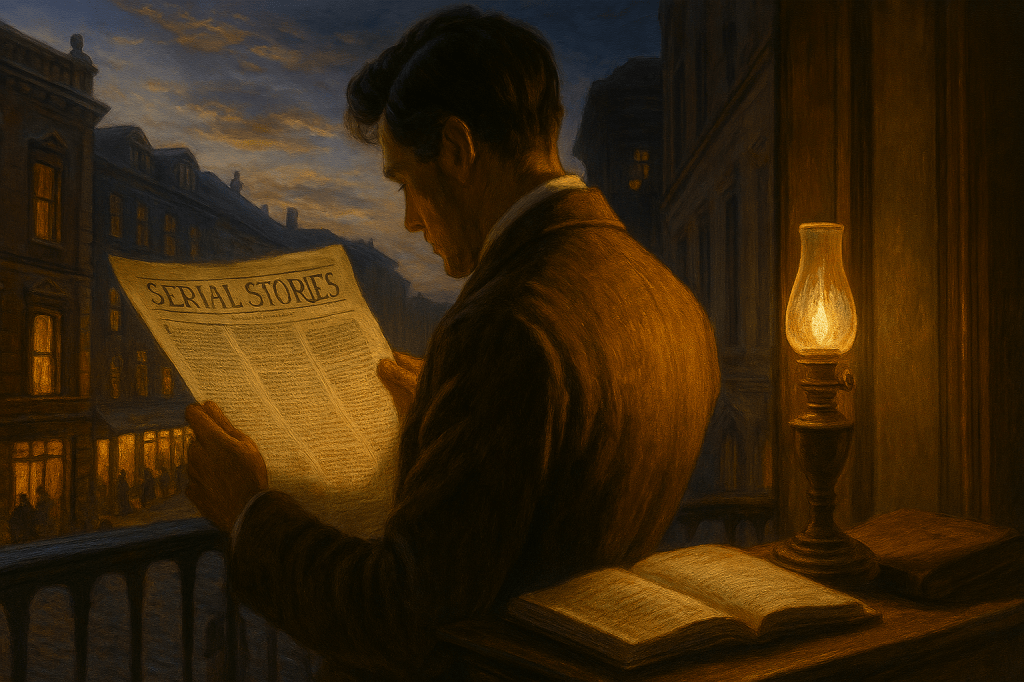
From the earliest days of mass printing, authors discovered that releasing stories in instalments created anticipation, affordability, and community. Readers followed narratives week by week, discussed them in parlours and cafés, and waited for the next chapter with eagerness. Serialisation was not just a format—it was a cultural phenomenon.
We stand in that tradition. Like Dickens’s Pickwick Papers or Dumas’s The Three Musketeers, our stories arrive in fragments—each instalment a careful chapter, a self-contained moment, yet part of a larger reckoning.
- Charles Dickens (1812–1870): Serialised Great Expectations in weekly magazines, making literature accessible to working-class readers. He pioneered serial publication. His serials made literature more accessible to the working class and shaped Victorian reading habits.
- Alexandre Dumas (1802–1870): Serialised The Count of Monte Cristo and The Three Musketeers in French newspapers like Le Journal des Débats and Le Siècle. These feuilletons (fr. meaning “little leaf” or “leaflet.) were immensely popular and helped define the adventure genre for mass audiences.
- Fyodor Dostoevsky (1821–1881): – Crime and Punishment was serialised in The Russian Messenger in 1866. Dostoevsky often relied on serial publication due to financial pressures yet produced some of the most psychologically rich novels of the 19th century. His admiration for Dickens is also well-documented.
- John Steinbeck (1902–1968): – Published parts of The Grapes of Wrath in The San Francisco News in 1939 as a series titled “The Harvest Gypsies,” which laid the groundwork for the novel. These articles sparked public debate on migrant labour and poverty in America.
- Stephen King (1947– ): Revived the serial format with The Green Mile in 1996, releasing it in six monthly instalments. He explicitly cited Dickens as an influence and proved that serialisation could still captivate modern readers.
This is why we publish in episodes: to honour and revive that tradition. Serialisation lets stories breathe, linger, and be remembered in pieces. Each instalment is a lighted fragment of a larger story. Every fragment builds toward moral intersections of duty, desire, morality, and memory.
Read for mood, stay for reckonings.
 Lamp & Ledger